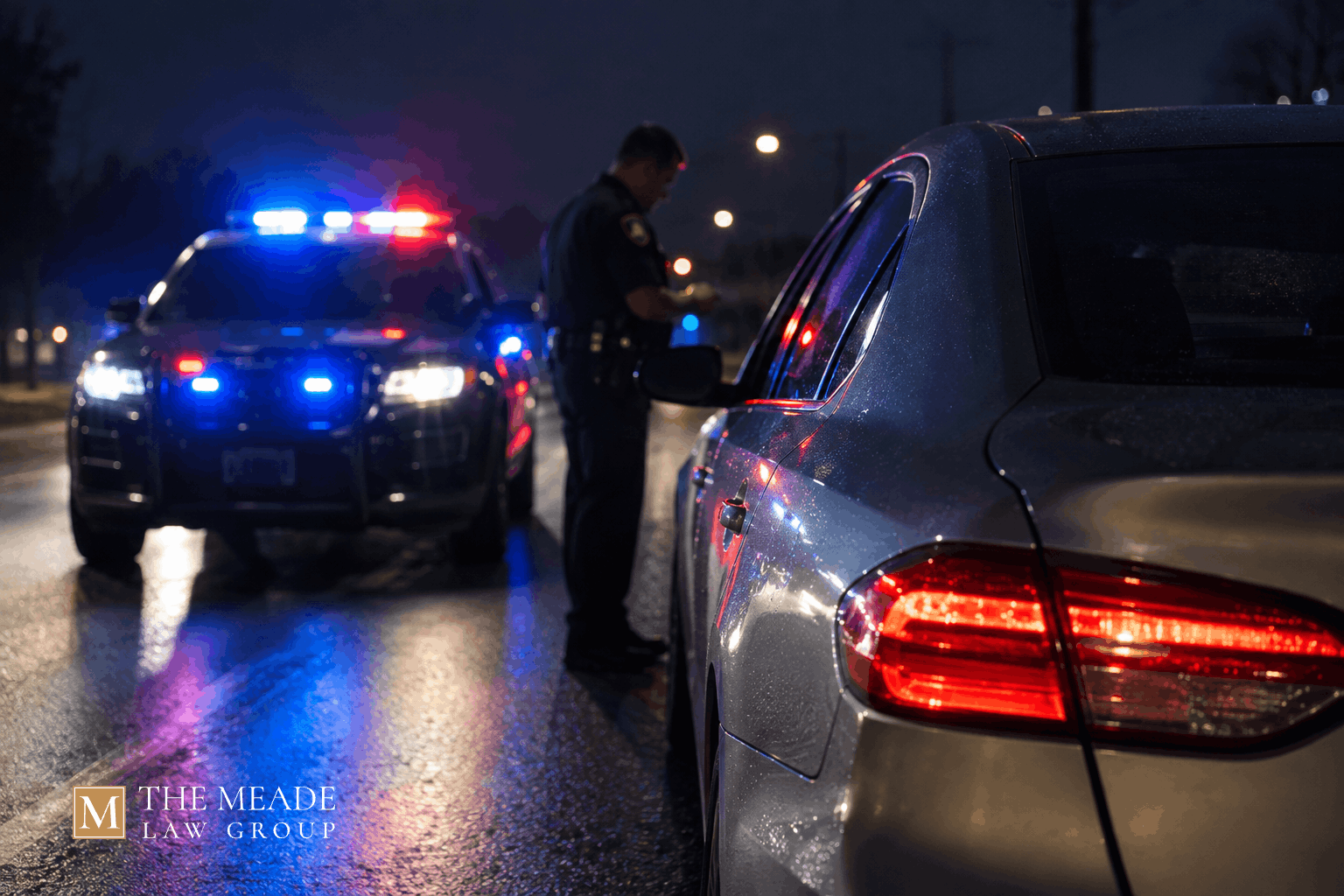

Blue lights fill your mirror, and for a few seconds your mind races. Maybe you panic, maybe you tell yourself you will just get to a safer spot, maybe you simply do not stop quickly enough. Those few seconds can change everything.
In Ohio, not pulling over for a police officer is not brushed aside as a traffic matter. It is called failure to comply, and the version that involves a vehicle is now a felony, even the first time. A split-second choice can turn an ordinary stop into a charge that carries prison time and the loss of your license for years.
If you are facing a failure to comply or fleeing and eluding charge in Ohio, understanding how the law works, and how recently it changed, is the first step toward protecting yourself.
What Is Failure to Comply in Ohio?
Failure to comply is defined in ORC 2921.331, under the section titled failure to comply with an order or signal of a police officer. Most people know it by its everyday name, fleeing and eluding. The two phrases describe the same Ohio offense.
At its core, the law covers refusing a police officer’s lawful command on the road. How serious that refusal becomes depends almost entirely on whether a vehicle was used to get away.
The Two Forms: Disobeying an Officer vs. Fleeing in a Vehicle
The statute splits into two very different offenses, and the gap between them is enormous:
- Disobeying an officer directing traffic (division A): Failing to follow the lawful order or direction of an officer who is controlling or regulating traffic, such as ignoring an officer who waves you through or tells you to stop at a crash scene. This is the less serious form.
- Fleeing or eluding in a vehicle (division B): Willfully operating a vehicle to elude or flee an officer after a signal to stop. This is the serious form, and it is the one that now carries felony consequences.
Nearly everything that makes this charge frightening comes from division B.
Failure to Comply vs. Fleeing and Eluding vs. Resisting Arrest
These terms get mixed up constantly, and the difference matters. Failure to comply and fleeing and eluding are the same thing, Ohio’s name for refusing to stop for police. Resisting arrest, by contrast, is a separate offense under a different statute that involves physically resisting or interfering with an arrest that is already underway. A single encounter can lead to one, the other, or both, but they are not interchangeable.
Is Failure to Comply a Felony in Ohio?
For the vehicle form, the answer is now yes, and that is a recent change worth understanding.
As of October 24, 2024, willfully fleeing or eluding a police officer in a vehicle is a felony in Ohio, even for a first offense. Before that change, prosecutors could charge the same conduct as a first-degree misdemeanor. Many older articles and assumptions still treat it that way, but the current law is stricter.
The one part that remains a misdemeanor is the Division A form, disobeying an officer who is directing traffic without any vehicle flight. Anything involving actually fleeing in a car now starts as a felony.
Penalties for Failure to Comply / Fleeing and Eluding in Ohio
Because the charge spans a misdemeanor and two felony levels, the consequences range from modest to severe. Two things drive the outcome: the form of the offense, and the danger created while fleeing.
Charge Levels and Prison Time
| Offense | Level | Prison or Jail | Maximum Fine |
| Disobeying a traffic officer (division A) | First-degree misdemeanor | Up to 180 days | $1,000 |
| Fleeing or eluding in a vehicle (division B) | Fourth-degree felony | 6 to 18 months | $5,000 |
| Fleeing after a felony, or creating a substantial risk of serious harm | Third-degree felony | 9 to 36 months | $10,000 |
By a special rule in the statute, any prison term for felony fleeing under division B must be served consecutively to the offender’s other sentences, which can stack years on top of the underlying case.
The Mandatory License Suspension
The license consequences catch many drivers off guard. A felony failure to comply conviction carries a mandatory class two license suspension of three years to life. The first three years cannot be reduced or suspended by the judge, and no driving privileges are allowed during that time.
A repeat offender faces a class one suspension and a lifetime loss of driving privileges. The misdemeanor Division A form carries a shorter suspension, and limited driving privileges may be available.
What the State Must Prove
A felony charge is not the same as a felony conviction. To convict, the prosecutor has to prove several things beyond a reasonable doubt, and each one is a potential crack in the case:
- A lawful order or a signal to stop: The officer must have given a lawful order, or a visible or audible signal to stop, such as lights or a siren.
- Willful conduct: You must have willfully fled or eluded, meaning on purpose, not by accident or because you never realized you were being signaled.
- Awareness: The state generally must show you knew, or reasonably should have known, that an officer was signaling you to stop.
What Counts as “Willfully” Fleeing
The word willfully does a lot of work, and it is often where these cases are fought. Conduct that can support the charge includes:
- Speeding up or continuing to drive after lights and sirens activate.
- Taking turns or changing routes to lose the officer.
- Refusing to stop over an extended distance or period of time.
- Pulling over only after a prolonged pursuit.
But intent is not always clear. A driver who did not see or hear the signal, who kept going a short way to reach a safe and well-lit place to stop, or who was unsure whether the vehicle behind them was actually a police car may not have acted willfully at all.
When Failure to Comply Becomes Part of a Bigger Case
Fleeing rarely happens on its own. In most cases, the driver had a reason not to want the stop, and that reason becomes part of the case. Failure to comply often appears alongside:
- An OVI: Many drivers flee because they fear an impaired-driving arrest, which then stacks an OVI on top of the felony.
- Driving under suspension: Drivers already dealing with a suspended license sometimes run rather than get caught, adding another charge.
- Fleeing after a felony: Running immediately after committing another felony is exactly what raises failure to comply to a third-degree felony.
- Reckless operation: High-speed fleeing frequently brings a separate reckless operation charge for the dangerous driving itself.
Each added charge changes the strategy, which is why these cases are rarely as simple as the fleeing count alone.
Common Defenses to a Failure to Comply Charge
Because the offense turns on specific facts and on the driver’s intent, there is often real room to challenge it. A defense is built around the weakest link in the state’s proof:
- No clear signal: Arguing that there was no visible or audible signal to stop, or that you genuinely did not perceive it.
- No willful flight: Showing you were looking for a safe place to pull over, were briefly confused, or did not realize an officer was behind you.
- Mistaken identity: Questioning whether you were actually the driver, especially after a pursuit where the driver was never clearly seen.
- Challenging the enhancement: Disputing the alleged substantial risk of serious harm that turns a fourth-degree felony into a third-degree felony.
- Attacking the underlying stop: If the attempted stop itself was unlawful, that can affect the entire case.
What to Do If You’re Charged With Failure to Comply
The choices you make right after the incident can shape the whole case:
- Do not keep running or hide. If you got away during the stop, there is likely a warrant for your arrest, and resolving it with a lawyer is far better than being found on it.
- Say nothing about why you did not stop. Your explanation can be used against you, so save it for your attorney.
- Write down what happened while it is fresh, including whether you saw lights or heard a siren and where you intended to pull over.
- Preserve any evidence. Dashcam video, phone data, or witness details about the route and conditions can all matter.
- Talk to a criminal defense attorney quickly. With a felony and a mandatory suspension on the line, early advice is important.
Why Choose The Meade Law Group
A failure to comply charge moves fast and hits hard, often turning a single bad decision into a felony with a mandatory, years-long license suspension. At The Meade Law Group, we focus on the two questions that decide these cases: whether you truly received and understood a signal to stop, and whether your driving was willful.
Our team handles failure to comply and felony defense throughout central Ohio, including the OVI, suspension, and reckless operation charges that so often come with it. We build the defense around the specific facts of the stop and the pursuit.
Our Services Include:
- Signal and intent review: Examining whether there was a lawful, perceivable signal and whether any flight was truly willful.
- Enhancement challenges: Contesting the substantial-risk findings that push the charge up to a third-degree felony.
- License protection: Confronting the mandatory suspension and pursuing every option the law allows.
- Full-case defense: Handling the related charges together so the strategy fits the whole situation.
Contact The Meade Law Group to schedule a confidential consultation.
Frequently Asked Questions (FAQs)
| Question | Answer |
| Can a fleeing and eluding charge be reduced to a misdemeanor in Ohio? | Sometimes. Weaknesses in intent, the signal, or the serious-harm enhancement can open the door to a reduction, though it is harder now that the base vehicle offense is a felony. |
| Can you get probation instead of prison for failure to comply in Ohio? | Sometimes, especially at the fourth-degree level, but it is an uphill climb. These are felony charges, and the statute requires any prison term for felony fleeing to run consecutively to other sentences, so the exposure is serious and probation is never guaranteed. |
| Can a failure to comply conviction be sealed or expunged in Ohio? | It is not guaranteed. Eligibility to seal a felony depends on the degree, your overall record, and whether the offense qualifies, so it is worth an individual review. |
| Does a failure to comply conviction affect a commercial driver’s license (CDL)? | Yes. A felony conviction and a multi-year suspension can be devastating for a commercial driver, often ending the ability to drive commercially. |
| Will I lose my license immediately, before I am even convicted? | The mandatory suspension is imposed at sentencing after a conviction, but a related OVI arrest can trigger a separate administrative suspension much earlier in the process. |