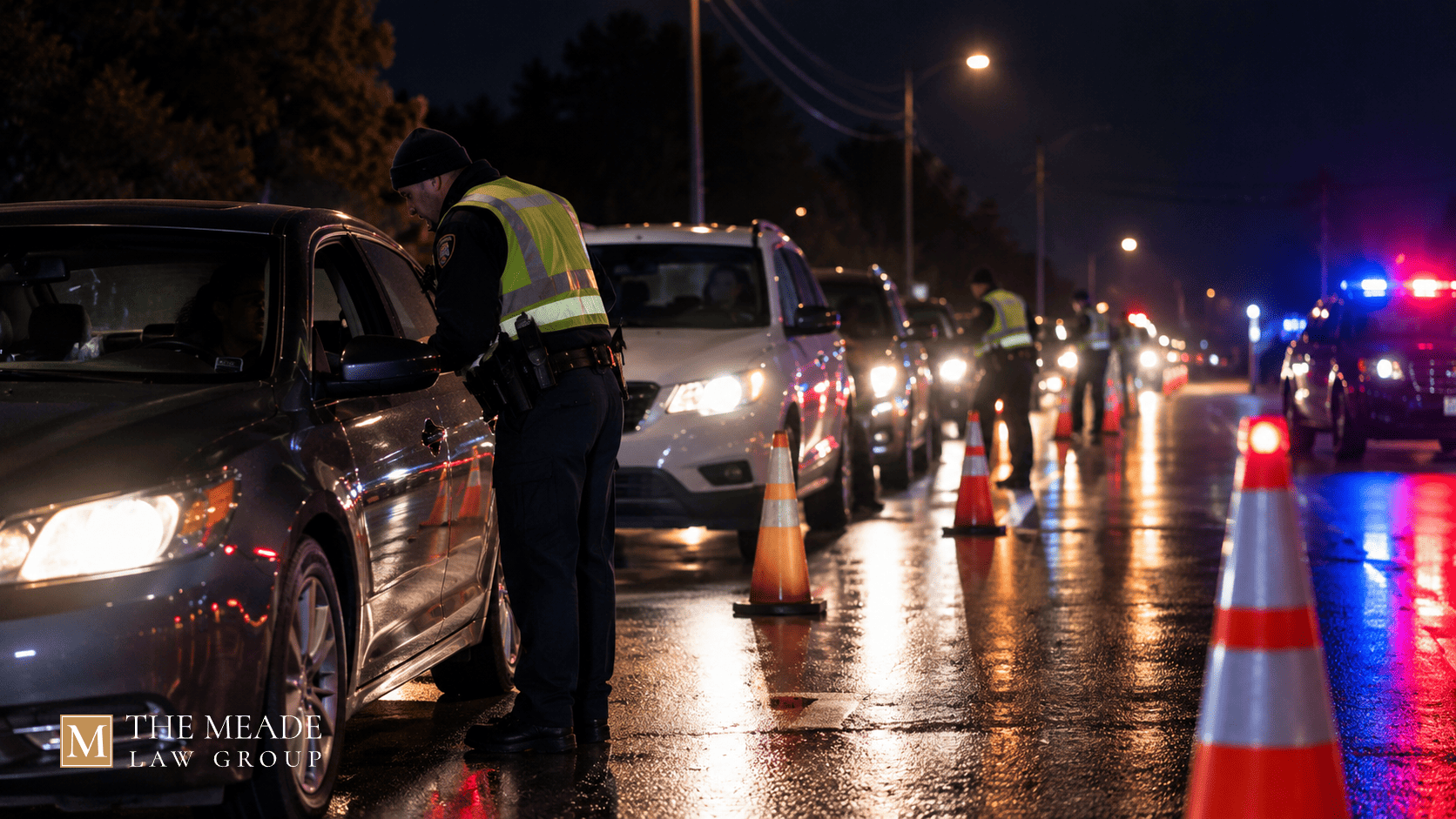
It is late, you are almost home, and then you see it ahead: a line of brake lights, orange cones, and flashlights waving cars forward one at a time. An officer leans toward your window and asks whether you have had anything to drink tonight. Even when the honest answer is no, your pulse jumps.
Sobriety checkpoints are built to feel exactly that way, routine and unavoidable. What most drivers do not realize is how many rules the police have to follow to run one, and how many rights you keep while sitting in that line.
If you are wondering whether sobriety checkpoints are legal in Ohio, what you are required to do, and what you can refuse, this guide walks through all of it.
What Is a Sobriety Checkpoint?
A sobriety checkpoint, also called a DUI or OVI checkpoint, is a planned roadblock where police stop vehicles to look for impaired drivers. Unlike a normal traffic stop, officers do not need any reasonable suspicion that you did something wrong. They stop cars using a fixed, neutral pattern, such as every vehicle or every third vehicle, and briefly check each driver for signs of impairment.
That is what makes checkpoints unusual. They are one of the few times police can stop you without suspecting you of anything, which is exactly why the law surrounds them with strict conditions.
Are Sobriety Checkpoints Legal in Ohio?
Yes. Sobriety checkpoints are legal in Ohio, and they have been for decades. The question reached the United States Supreme Court in Michigan Department of State Police v. Sitz (1990). The Court held that checkpoints are a reasonable search under the Fourth Amendment, reasoning that the public safety interest in stopping drunk driving outweighs the brief, minimal intrusion on drivers.
A handful of states, including Michigan itself, later banned checkpoints under their own constitutions, but Ohio is not one of them. Ohio courts follow Sitz and allow them. Legal does not mean unlimited, though. A checkpoint is only valid if it is run the right way.
The Rules an Ohio Checkpoint Must Follow
To stay constitutional, an Ohio checkpoint has to meet conditions set out in Ohio State Highway Patrol policy and in court decisions. The core requirements include:
- Advance public notice: The checkpoint is announced to the public ahead of time, usually through a media release.
- A neutral stopping pattern: Officers must stop cars by a set formula, not by singling out drivers at their own discretion.
- Supervisory planning: Command-level officers, not the officers working the road, decide the location and the procedures.
- A safe, visible location: The site needs clear, lit warning signs so drivers know it is an official checkpoint.
- A way to avoid it: Drivers must have the chance to turn away before entering.
- An impaired-driving purpose: The checkpoint has to target impaired driving. A roadblock set up mainly to search for drugs or general crime is unconstitutional (City of Indianapolis v. Edmond).
Your Rights at an Ohio Sobriety Checkpoint
Being waved into a checkpoint does not strip away your rights. You keep most of the same protections you have during any police encounter, and knowing them ahead of time keeps a routine stop from turning into something worse.
You do have to cooperate with the basics. But a lot of what officers ask for at a checkpoint is voluntary, even when it does not feel that way.
What You Must Do vs. What You Can Decline
| You Must | You Can Decline |
| Stop and provide your license, registration, and insurance | Answer questions about whether or where you have been drinking |
| Step out of the vehicle if lawfully ordered | Perform roadside field sobriety tests, which are voluntary |
| Comply with lawful instructions | Submit to a handheld roadside breath test |
Those roadside exercises matter more than they appear to. The standardized field sobriety tests are designed to build a case against you, and you are allowed to politely decline them. The rules change after a lawful arrest, however. Ohio’s implied-consent law (ORC 4511.191) means that refusing the official chemical test at the station brings an automatic license suspension, which is a very different decision from declining the voluntary roadside tests.
Can You Legally Turn Around to Avoid a Checkpoint?
This is one of the most common questions, and the answer surprises people: yes, you can legally avoid a sobriety checkpoint. The advance-notice requirement exists partly so that drivers have that option.
The catch is in how you do it. Avoiding a checkpoint is only protected if the maneuver itself is legal:
- A legal turn onto another street before the checkpoint zone is your right, and it is not, on its own, a reason for police to stop you.
- An illegal maneuver, such as an unsafe U-turn, crossing a median, driving over the shoulder, or running a signal, gives officers independent reasonable suspicion to pull you over.
Keep in mind that some departments position officers near a checkpoint to watch for drivers who turn away. A clean, lawful turn is protected, but a sloppy or illegal one hands them the exact reason they need.
When a Checkpoint Leads to an OVI Charge
If an officer notices signs of impairment at the checkpoint, the brief stop becomes a full OVI investigation, and the process moves quickly from there.
The OVI Investigation
At that point, the officer will usually ask you to step out and perform roadside tests, then request a chemical test if you are arrested. This is the same path as any first OVI stop, and the stakes are high. An arrest can lead to criminal charges and an OVI license suspension in Franklin County or wherever you were stopped. How you handle these moments, especially what you say and which tests you agree to, shapes everything that follows.
Challenging an Improper Checkpoint
Here is where a checkpoint case can turn. Because a checkpoint is only lawful when the rules are followed, one that was run improperly can be challenged. If there was no advance notice, no neutral stopping pattern, too much officer discretion, or inadequate signage, your attorney can file a motion to suppress and ask the court to exclude the evidence.
This is its own kind of Fourth Amendment argument, different from a typical unlawful search and seizure fight in a drug or search case, because it targets how the entire checkpoint was planned and operated. It is the first thing a criminal defense attorney examines in a checkpoint arrest.
Why Choose The Meade Law Group
A checkpoint arrest can feel open and shut, as if being stopped at an official roadblock already settles the question. It does not. At The Meade Law Group, we start by asking whether the checkpoint itself was legal, because if it was not, everything that followed may be challenged.
Our team defends OVI charges that begin at sobriety checkpoints throughout central Ohio, from the legality of the stop to the reliability of the tests used against you. We build the defense around the specific facts of how the checkpoint was run and how you were evaluated.
Our Services Include:
- Checkpoint review: Examining whether the checkpoint followed the required notice, planning, and neutral-pattern rules.
- Suppression motions: Moving to exclude evidence from a checkpoint that did not meet constitutional standards.
- Test challenges: Questioning the field sobriety and chemical testing used to support the charge.
- License protection: Addressing administrative suspensions and working to keep you on the road.
Contact The Meade Law Group to schedule a confidential consultation.
Frequently Asked Questions (FAQs)
| Question | Answer |
| How will I know if a sobriety checkpoint is happening in my area? | Because Ohio requires advance public notice, checkpoints are usually announced beforehand through local news and law enforcement press releases, so they are rarely a secret. |
| Can the police search my car at a sobriety checkpoint? | Not without your consent or probable cause. A checkpoint is limited to screening for impaired driving, and officers cannot use it as a reason for a full search of your vehicle. |
| What happens at a sobriety checkpoint if I am under 21? | A stricter limit applies. Drivers under 21 can face an OVI-type charge at a much lower blood-alcohol level of 0.02, so even a small amount of alcohol can lead to an arrest. |
| Do passengers have to show ID or answer questions at a checkpoint? | Generally no. The stop is directed at the driver, and passengers usually are not required to show identification or answer questions, though staying calm and cooperative is wise. |
| Will being stopped at a checkpoint by itself go on my record? | No. Simply passing through or being briefly stopped is not a charge and creates no record. Only an actual arrest and charge would appear on your record. |