Being served with a protection order can turn your life upside down in a single afternoon. You may be told to leave your home, stay away from your children, and stop all contact with someone you have known for years, before a judge has heard a word from you.
Here is what matters most: that first order is temporary. Ohio law gives you the right to a full hearing, usually within 7 to 10 court days (days the court is open), where you can answer the accusations, bring evidence, and ask the court to deny a longer order. What you do between being served and that hearing often decides the outcome.
This guide explains how to fight a protection order in Ohio, how long it lasts, whether it goes on your record, and how it can be dropped or appealed. Ohio calls it a protection order, but most people know it as a restraining order.
What It Means When a Protection Order Is Filed Against You
A civil protection order (CPO) is a civil case, not a criminal charge. The person who files is the petitioner, and you are the respondent. No one is asking the court to convict you of a crime. The petitioner is asking a judge to order you to stay away for a set period of time.
That does not make it minor. A CPO can control where you live, when you see your children, and whether you can own a gun. The two main types work like this:
| Type | Who Can File Against You | Where It Is Heard in Franklin County |
| Domestic violence CPO (R.C. 3113.31) | A spouse, former spouse, partner, or relative who lives or once lived with you, the other parent of your child, or someone you had a romantic or intimate relationship with in the last 12 months | Domestic Relations and Juvenile Court, 373 South High Street |
| Stalking or sexually oriented offense CPO (R.C. 2903.214) | Anyone, including a neighbor, coworker, or stranger, if you are 18 or older | Court of Common Pleas, 345 South High Street |
A stalking CPO is usually based on menacing by stalking, explained in our guide to menacing charges in Ohio. For every other kind of order, including criminal orders, see our guide to Ohio protection orders.
The Ex Parte Order: What It Does Before You Are Heard
Most cases start with an ex parte order, issued after the judge heard only the petitioner. The law allows this when the petitioner shows immediate and present danger.
In a domestic violence case, the ex parte hearing happens the same day the petition is filed. In a stalking case, it happens no later than the next day the court is in session.
Even though it is temporary, an ex parte order can:
- Remove you from your home: In a domestic violence case, the court can order you to leave, even if you own or lease the home jointly with the petitioner.
- Set temporary custody: In a domestic violence case, the court can decide temporary parenting time if no other court is handling custody.
- Bar you from places: The order can keep you away from the petitioner’s home, work, school, and business.
The ex parte order stays in effect until the full hearing. It does not expire just because service was delayed or the hearing was postponed.
What to Do Right After You Are Served
The days after service are when respondents make the hardest mistakes to undo. Follow these steps:
- Read every term: Note the hearing date, every place you must avoid, and any custody or firearm terms. Keep the paperwork somewhere safe.
- Obey the order completely: Do not call, text, message, or post about the petitioner, and do not ask friends or family to pass along messages.
- Do not accept an invitation: Ohio law requires the order to state that it cannot be waived by an invitation from the petitioner. If they call you or ask you to come over, you are the one who can be arrested.
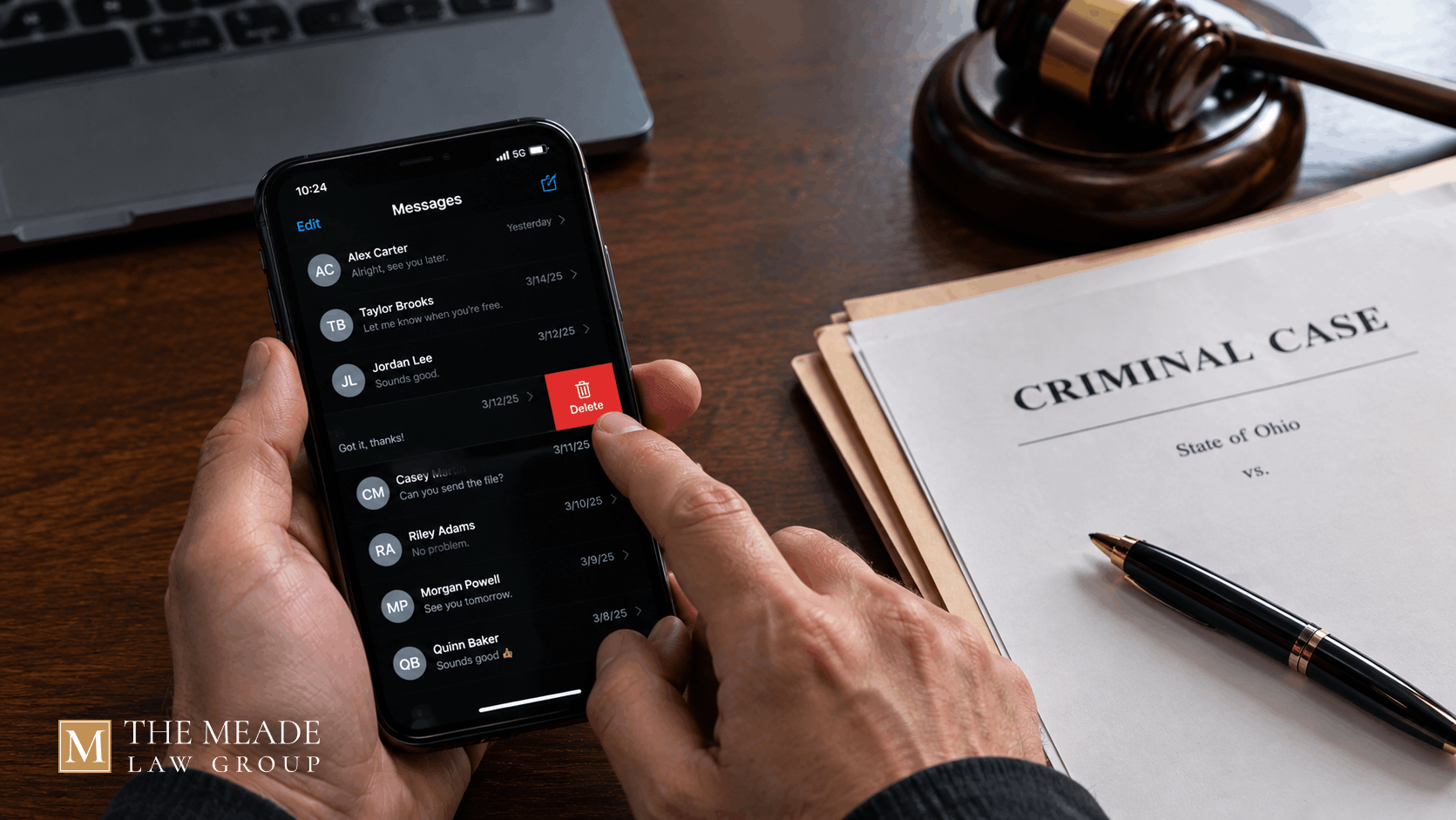
- Save your evidence: Preserve texts, emails, call logs, social media messages, and photos. Do not delete anything, even messages that look bad.
- Write a timeline: List dates, places, and the names of people who saw or heard what happened while your memory is fresh.
- Talk to a lawyer before the hearing: If you need time to hire one, the court can postpone the hearing so you can obtain counsel. The ex parte order stays in place while you wait.
Violating any term, even once, can lead to a criminal charge under R.C. 2919.27 and contempt of court. If police also arrested you, the criminal court may issue its own separate order, and you will need a domestic violence defense attorney for that case as well.
How to Fight a Protection Order in Ohio at the Full Hearing
The full hearing is a trial-style hearing in front of a judge or magistrate. Both sides can testify, call witnesses, and present documents. In a domestic violence case, it must be scheduled within 7 court days if the ex parte order put you out of the home, and within 10 court days in other cases. Stalking cases follow the 10-day rule.
If you do not appear, the hearing can go forward without you, and the court can issue a full order based only on the petitioner’s evidence. Showing up prepared is the single most important step in fighting a protection order.
What the Petitioner Has to Prove
The petitioner carries the burden. The Ohio Supreme Court held in Felton v. Felton (1997) that a domestic violence CPO requires proof by a preponderance of the evidence, meaning it is more likely than not that the petitioner or their family is in danger of domestic violence.
Specifically, a domestic violence petitioner must show a qualifying relationship and an act of domestic violence, such as causing or attempting bodily injury, threatening force that caused fear of imminent serious harm, or committing a sexually oriented offense.
A stalking petitioner must show a pattern of conduct, which means two or more incidents closely related in time, that made the petitioner believe you would cause physical harm or caused them mental distress. A petition based on a sexually oriented offense does not require a pattern.
Evidence and Defenses That Matter
Judges respond to specific, consistent evidence. Common defenses include:
- No qualifying relationship: A casual acquaintance or ordinary work or social contact is not a dating relationship under the domestic violence statute.
- No threat or no fear: Rude or angry words are not the same as a threat of serious physical harm, and the fear must be reasonable.
- No pattern: A single argument usually does not meet the stalking standard.
- Inconsistent story: Messages, timestamps, and witnesses that contradict the petition can undercut the petitioner’s credibility.
- Other motives: A petition filed in the middle of a divorce or custody dispute deserves scrutiny, and the timing can be shown with evidence.
Our protection order attorneys prepare respondents for this hearing by organizing the evidence, preparing witnesses, and cross-examining the petitioner.
Consent Agreement vs. a Contested Hearing
Instead of a contested hearing, the parties can agree to a consent agreement that the court approves. It lets both sides avoid testifying, and the terms can sometimes be negotiated, such as how contact about the children will work.
Understand the trade-off before signing. A consent agreement can last up to five years, violating it carries the same criminal and contempt consequences as a protection order, and the court must give you the same firearm warning it gives for a full order. Never sign one before you have reviewed the terms with a lawyer.
How Long Does a Protection Order Last in Ohio?
A full civil protection order lasts until a date the judge sets, up to five years from the date it is issued. Both the domestic violence and stalking statutes use the same five-year limit, and both allow the petitioner to renew the order the same way it was first obtained.
A few exceptions shorten that period:
- Respondents under 18: A domestic violence order ends no later than the respondent’s 19th birthday.
- Custody and support terms: These parts end when a divorce, dissolution, or juvenile court issues its own custody or support order.
- Early termination: The court can modify or end the order on a motion, as explained below.
The full text of these rules is in Ohio Revised Code 3113.31.
Does a Protection Order Go on Your Record?
A civil protection order is not a criminal conviction, so it does not create a criminal record by itself. That does not mean it is invisible.
Every order is sent to the law enforcement agencies that enforce it, and Ohio enters protection orders into the LEADS Protection Order File, which is available to the national firearm background check system. The case itself also remains a court record.
Ohio law seals these records automatically in only two situations:
- The court denies the full order: If the judge refuses to grant a protection order after the full hearing, the court must seal the ex parte order and all related records once the time to appeal has passed.
- The respondent was a minor: In a domestic violence case, the records are sealed when the respondent turns 19, as long as they complied with the order.
That first rule is a strong reason to fight the order at the full hearing instead of letting it be granted by default.
How a Protection Order Affects Your Guns, Home and Children
Firearms: Every Ohio protection order and consent agreement must warn that you may not be able to possess or buy a firearm or ammunition under 18 U.S.C. 922(g)(8) while the order lasts. The U.S. Supreme Court upheld this ban against a Second Amendment challenge in United States v. Rahimi (2024).
The federal ban applies to orders issued after a hearing you were notified of and could take part in, and only when the order protects an intimate partner or that partner’s child. An intimate partner is a spouse, former spouse, the other parent of your child, or a partner you live or lived with.
A dating partner you never lived with does not count, and an ex parte order alone does not trigger the ban. If you own firearms, get legal advice before the full hearing.
- Your home: The court can order you out of a home you share with the petitioner. The order does not change who owns the property, but you can be barred from living there while it is in effect.
- Your children: In a domestic violence case, the court can set temporary custody and parenting time if no other court is deciding those issues. If a child is in danger and no one else can supervise, it can order supervised parenting time through children services for up to nine months.
A protection order can also affect a later custody case, because Ohio judges consider domestic violence when deciding custody. Learn more about how Ohio courts decide custody.
Can a Protection Order Be Dropped, Modified or Appealed?
Yes, but each path has its own rules and deadlines. Missing a deadline can leave a five-year order in place.
Can the Petitioner Drop It?
Before the full hearing, the petitioner can ask the court to dismiss the petition. Once a full order is issued, however, the petitioner cannot simply cancel it. The court must approve any change, and until it does, contact with the petitioner can still lead to a violation charge, even if they started it.
Filing a Motion to Modify or Terminate the Order
Under the domestic violence statute, either side can file a motion to modify or terminate an order that was issued after a full hearing. The motion goes to the court that issued the order, and the person filing it must show the order is no longer needed or its terms are no longer appropriate.
The court considers all relevant factors. The statute lists 12 of them, including:
- Petitioner’s position: Whether the petitioner agrees to the change and still fears you.
- Your compliance: Whether you followed every term of the order.
- Treatment: Whether you completed counseling or a domestic violence program.
- Time and circumstances: How long it has been, your current relationship, and whether you share children or live and work near each other.
- New problems: Any new offense of violence, other protection orders, or drug or alcohol issues.
If the court denies a respondent’s motion, it can order the respondent to pay the costs of filing it.
Objections and Appeals: The 14-Day Deadline
A full order is often issued by a magistrate. If a magistrate decided your case, Ohio Civil Rule 65.1 requires written objections within 14 days of the court’s filing of the order before you can appeal. If a judge decided it, you generally have 30 days to appeal.
Ohio appeals courts regularly dismiss appeals when no timely objections were filed. Filing objections does not pause the order, so you must keep obeying it while the objections are pending.
Why Choose The Meade Law Group
A protection order case moves faster than almost any other case in Ohio courts, and you may have only days to prepare. The Meade Law Group represents respondents in Franklin, Delaware, and Fairfield Counties and handles the family law and criminal issues that often come with these cases.
Our Services Include:
- Full hearing defense: Preparing your testimony, organizing evidence, and cross-examining the petitioner.
- Consent agreement review: Making sure you understand every term, including firearm and custody effects, before you agree.
- Related cases: Defending criminal charges and protecting your parenting time in a divorce or custody case.
- Post-order relief: Filing objections, appeals, and motions to modify or terminate an order.
Contact The Meade Law Group to schedule a confidential consultation.
Frequently Asked Questions
| Question | Answer |
| Do I have to go to the full hearing? | You are not forced to attend, but if you do not, the court can issue a full order lasting up to five years based only on the petitioner’s evidence. |
| What if the petitioner contacts me first? | Do not respond. The order binds you, not the petitioner, and an invitation does not cancel it. Save the message and tell your lawyer. |
| Is a protection order a criminal charge? | No. A civil protection order is a civil case. Violating the order, however, is a crime under R.C. 2919.27. |
| Will a protection order show up on a background check? | It is not a criminal conviction, but it is entered in the LEADS Protection Order File and used in firearm background checks. The court case also remains on record unless it is sealed. |
| Can I get a protection order against the petitioner? | Only by filing your own petition. The court cannot restrict the petitioner in their case unless you file separately and prove your claims at a hearing. |
| Who pays the court costs? | The petitioner cannot be charged any fees. The court can assess costs against the respondent, whether or not an order is granted. |
| Do I need a lawyer for a protection order hearing? | It is not required, but the hearing works like a short trial with evidence and cross-examination, and the result can last five years. The court can postpone the hearing so you can hire one. |