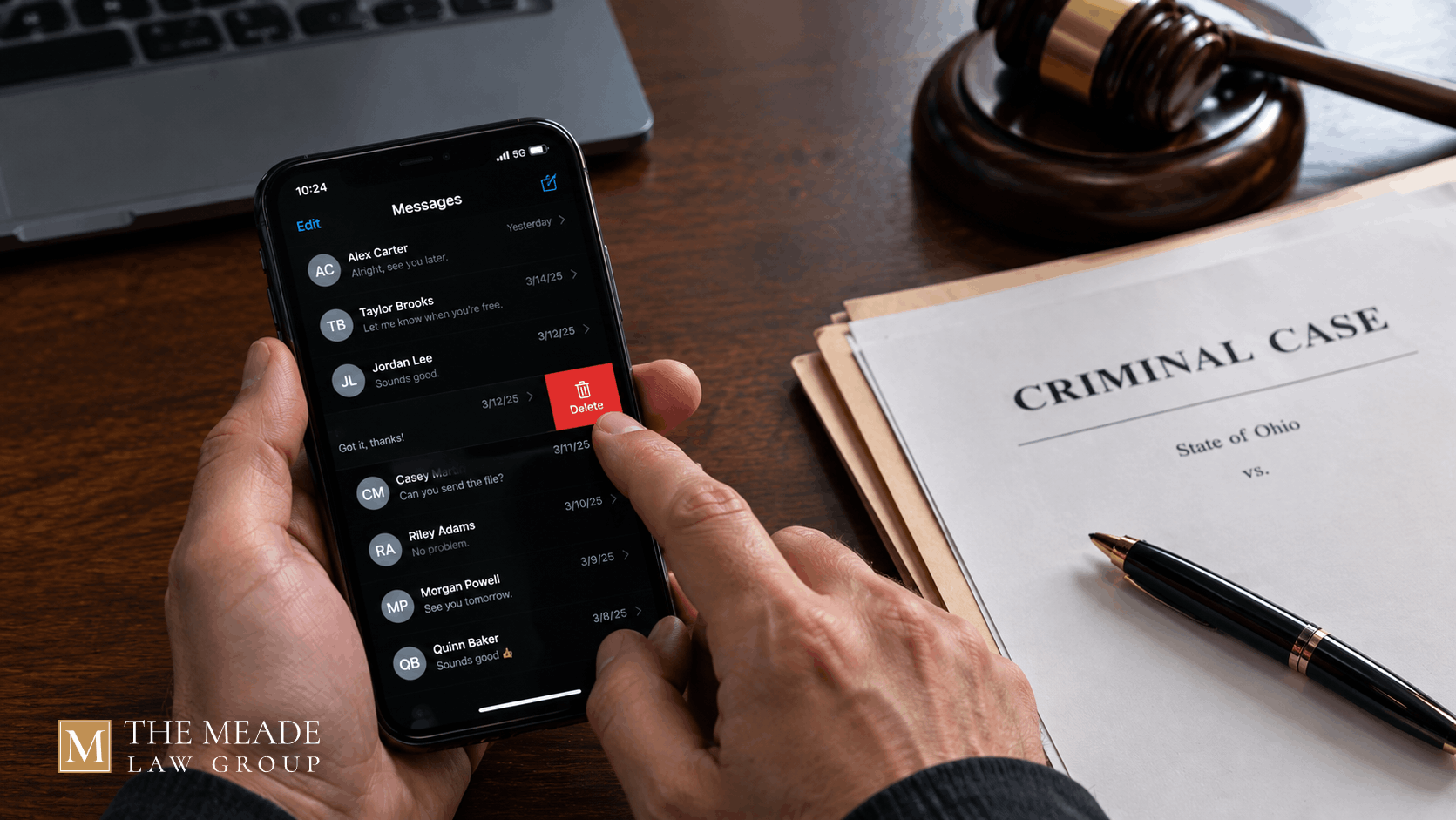
A relationship ends badly, an argument spills over, or a dispute with a neighbor or coworker keeps escalating. You fire off a string of texts, call a few times to get an answer, or post something about the other person online to let off steam. It feels like venting, not a crime.
Then an officer calls, or a charge arrives in the mail, and the word attached to it is one most people have never heard: telecommunications harassment. In Ohio, that heated reaction can become a criminal case, and on a second offense it can become a felony.
If you are facing a telecommunications harassment charge in Ohio, the law is far more specific than it first appears, and that detail is exactly where a real defense lives.
What Is Telecommunications Harassment in Ohio?
Telecommunications harassment is defined in ORC 2917.21. It is the formal name for using a phone, computer, or any other device to abuse, threaten, or harass another person. It is the charge behind what most people simply call harassing phone calls, harassing text messages, or online harassment.
The statute is built in two parts. Division (A) lists eleven specific situations where making a communication crosses the line, such as calling someone after being told to stop, making threatening or obscene remarks, or calling at odd hours in a repeated and offensive way. Division (B) is broader. Division (B)(1) covers any telecommunication made with the purpose to abuse, threaten, or harass, and division (B)(2) reaches posting text, images, or audio about someone on a website or web page for that same purpose.
The Behaviors the Law Actually Covers
Because the law is written around how a communication is used rather than the device itself, it reaches almost any modern form of contact. Conduct that can lead to a telecommunications harassment charge includes:
- Repeated unwanted phone calls, including calling and hanging up over and over.
- Harassing or threatening text messages.
- Emails, direct messages, and app-based messages.
- Social media or website posts about a person, which fall squarely under division (B)(2).
- Continuing to contact someone after being clearly told to stop.
- Using a device to flood or disable another person’s phone or electronic device.
Ohio defines “telecommunication” very broadly. Under ORC 2913.01, it covers the transmission of data, images, signals, or sounds over any communication system by any electronic, digital, or analog method, and a “telecommunications device” expressly includes a computer, a telephone, and a cell phone. In practice, a single angry text message and a threatening voicemail are treated the same way under the law.
It’s About Purpose, Not Just Contact
Here is the detail that decides most cases. For the majority of the offense, the state must prove you acted with purpose to abuse, threaten, or harass. Contact alone, even unwanted or upsetting contact, is not automatically a crime.
That one word, purpose, is often what separates a message that is simply rude or unwelcome from one that is actually criminal. It is also where many of these charges fall apart.
How Many Calls or Texts Count as Harassment?
One of the most common questions has a surprising answer: there is no magic number. Ohio law sets no threshold of calls or messages that automatically becomes harassment.
A single message can be enough if it was sent with the purpose to abuse, threaten, or harass, such as a genuinely threatening text. At the same time, dozens of messages may not qualify if they were sent for a legitimate reason, such as an urgent co-parenting matter.
What the state looks at is not a tally but two things: your purpose in sending the communications, and whether the conduct fits one of the categories the statute describes, such as continuing to contact someone after a clear instruction to stop.
Telecommunications Harassment vs. Menacing and Stalking
These charges are easy to confuse because they can all grow out of the same conflict, but they target different conduct. Understanding the difference matters, because the facts may fit one offense and not another.
| Offense | What It Targets | Threat Required? |
| Telecommunications harassment (ORC 2917.21) | Using a device to abuse, threaten, or harass | No |
| Menacing (ORC 2903.22) | A threat that makes someone fear physical harm | Yes |
| Menacing by stalking (ORC 2903.211) | A pattern of conduct causing fear or mental distress | A pattern, not always a direct threat |
In short, telecommunications harassment is about the communication itself and does not require any threat, while menacing charges require a threat that causes fear of harm. A single incident can lead to more than one of these charges at once, which is one more reason the specific wording of each count matters.
Is Telecommunications Harassment a Felony in Ohio?
For most people, the first charge is a misdemeanor of the first degree, not a felony. That is the top misdemeanor level in Ohio, but it is still a misdemeanor.
The picture changes on a repeat. A second or subsequent telecommunications harassment offense is a felony of the fifth degree. The jump from misdemeanor to felony is what makes a prior conviction so significant in these cases.
When the Charge Becomes a Felony
Two paths turn this offense into a felony:
- A subsequent offense: Once you have a prior telecommunications harassment conviction, the next one is charged as a fifth-degree felony.
- Serious economic harm: The specific form involving a threat to damage property (division (A)(4)) escalates with the loss caused. Economic harm of $1,000 to under $7,500 makes it a fifth-degree felony, $7,500 to under $150,000 a fourth-degree felony, and $150,000 or more a third-degree felony.
Penalties and Consequences in Ohio
The sentence depends on whether the charge is a misdemeanor or a felony, but the courtroom penalty is only part of the cost.
As a first-degree misdemeanor, a first offense can bring up to 180 days in jail and a fine of up to $1,000. As a fifth-degree felony, a repeat offense carries six to twelve months in prison and a fine of up to $2,500, along with the lasting weight of a felony record.
Beyond the Sentence
The consequences often outlast any sentence. A conviction for a crime defined by abuse or threats can be especially damaging on a background check, affecting jobs and professional licenses. These charges also tend to travel with a protection order, which separately restricts your contact and movements, and when the other person is a family or household member, the case can overlap with domestic violence charges and the firearm consequences that come with them.
Common Defenses to a Telecommunications Harassment Charge
Because the offense turns on your purpose, it is a charge with real room to fight. Ohio courts have kept the law tightly focused on genuine harassment rather than on speech that is merely rude or unwelcome. A strong defense usually targets one of these points:
- No purpose to harass. This is the heart of most cases. In State v. Ellison, an Ohio appeals court reversed a conviction because the state could not prove the required purpose, and made clear that knowing a message might upset someone is not the same as intending to harass. An annoying or offensive message, on its own, is not a crime.
- The recipient’s reaction is not the test. In State v. Smith, the court held that the purpose to abuse, threaten, or harass must exist at the moment the communication is made, and that the other person simply feeling threatened is not enough to convict. The focus stays on what you intended, not on how it landed.
- A legitimate purpose. Messages sent for a real reason, such as co-parenting logistics, a business or debt matter, or warning others about genuine conduct, fall outside the statute.
- Protected speech. The First Amendment protects a great deal of unpleasant expression, and the law’s purpose requirement is exactly what keeps it from criminalizing offensive speech.
- Mistaken identity. Spoofed numbers, a shared or hacked account, or another person using your device can all put the wrong name on a message.
What to Do If You’re Accused of Telecommunications Harassment
The steps you take right after an accusation can shape the entire case:
- Stop all contact immediately. That includes contact through friends or family, because encouraging others to reach out can itself be part of the offense.
- Do not delete messages or posts. Removing the communications can look like destroying evidence and can take away the context that helps you.
- Save the full conversation. Preserve the entire thread, not just the message that was flagged, so your purpose can be seen in context.
- Do not explain your intent to the police. Your purpose is the exact element the state has to prove, so an explanation can hand it to them.
- Talk to a criminal defense attorney early. Because the case turns on intent, the right guidance from the start can change the outcome.
Why Choose The Meade Law Group
A telecommunications harassment charge turns on one narrow question: what you actually intended when you made contact. At The Meade Law Group, we build the defense around that question, because Ohio law, and the Ohio courts applying it, have given defendants far more protection than the charge first suggests.
Our team handles telecommunications harassment and related criminal defense matters throughout central Ohio, including the protection order and domestic violence issues these cases so often involve. We look hard at whether the state can truly prove a purpose to abuse, threaten, or harass, and we hold it to that burden.
Our Services Include:
- Purpose and intent review: Testing whether the state can prove you acted with the specific purpose the law requires.
- Context and evidence analysis: Examining the full message history, timing, and circumstances rather than a single screenshot.
- Protection order defense: Addressing the related civil protection order that often accompanies the criminal charge.
- Record protection: Working to avoid a conviction and the lasting mark it leaves, especially on a repeat offense that carries felony exposure.
Contact The Meade Law Group to schedule a confidential consultation.
Frequently Asked Questions (FAQs)
| Question | Answer |
| Can a social media post be telecommunications harassment, even if I never sent it directly to the person? | Yes. Division (B)(2) of the statute specifically covers posting text, images, or audio about someone on a website or web page with the purpose to abuse, threaten, or harass, so a public post can qualify even without any direct message. |
| Can I be charged for texting my ex during a custody dispute? | It depends on content and purpose. Messages that are genuinely about co-parenting usually serve a legitimate purpose, but if the texts become abusive or threatening, that legitimate purpose can disappear and a charge becomes possible. |
| Can the charge be dropped if the other person does not want to pursue it? | Not on their own. Once a report is made, the decision to prosecute belongs to the state, not to the person who complained. Their wishes can influence the prosecutor, but they cannot simply call it off. |
| Is telecommunications harassment the same as a domestic violence charge? | No. It is a separate offense, but when the two people are family or household members, telecommunications harassment often arises alongside a domestic violence case, and understanding how a protection order and a domestic violence charge differ becomes part of the picture. |
| Will a conviction show up on a background check, and can it be sealed? | A conviction does appear on your record. Whether it can later be sealed depends on the degree of the offense, your overall record, and the applicable waiting period, so eligibility is worth an individual review. |