
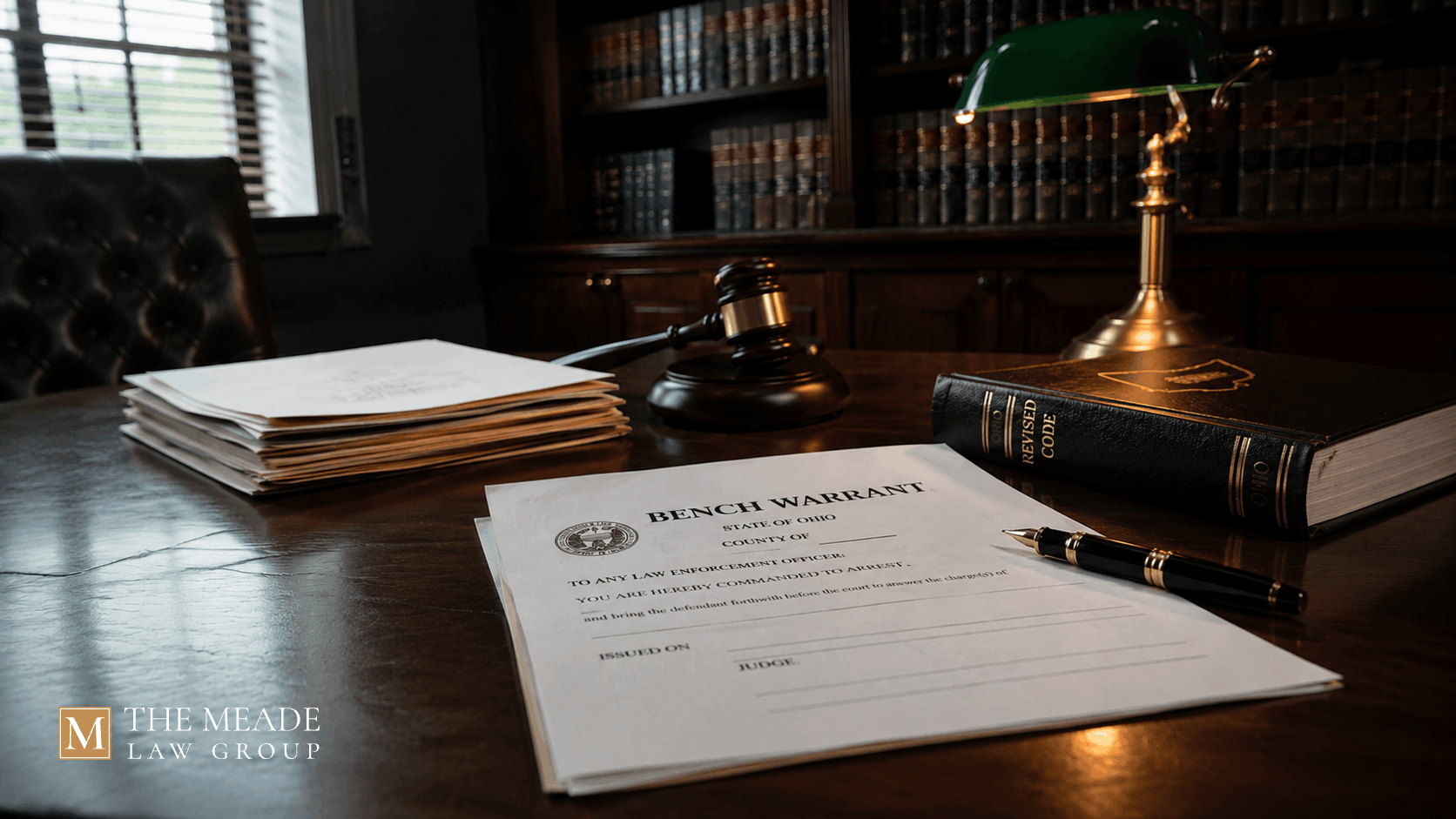
Finding out you might have an active warrant hanging over your head is a terrifying experience. You might be afraid to drive to work, fearful of a routine traffic stop, and constantly looking over your shoulder. The stress of not knowing when or where an arrest could happen takes an immediate toll on you and your family.
Ignoring the problem will only make the situation worse. The legal system does not forget missed court dates, but taking proactive steps can help you regain control of your life. Facing the issue head-on is always better than waiting for law enforcement to find you at your job or in front of your children.
This guide will help you understand exactly what a bench warrant means under Ohio law. You will learn why judges issue them, the serious consequences of ignoring one, and the proper legal steps to resolve the issue before it leads to an unexpected arrest.
What Is a Bench Warrant in Ohio?
If you are wondering what a bench warrant is, the answer is very straightforward. A bench warrant is a legal order issued directly by a judge from the bench while the court is in session. It authorizes law enforcement officers to arrest you and bring you before the court to address a specific issue.
The bench warrant’s meaning is tied strictly to compliance. Unlike other types of warrants, this order is usually issued because you failed to follow a specific instruction given by the court. The judge demands your presence to hold you accountable for the missed obligation.
Bench warrant vs. arrest warrant in Ohio
Many people confuse the different types of warrants, but they originate from entirely different parts of the justice system. The main difference between a bench warrant vs arrest warrant comes down to who asks for it and why it is issued.
The table below outlines the core distinctions between the two:
| Feature | Bench Warrant | Arrest Warrant |
| Who Issues It | A judge acting on their own authority. | A judge, but requested by police or prosecutors. |
| Why It Is Issued | To enforce compliance with a court order. | Based on probable cause that a new crime was committed. |
| What Triggers It | Missing court, unpaid fines, violating probation. | A new criminal investigation or grand jury indictment. |
| Typical Context | You already have an open case or obligation. | The very beginning of a brand new criminal case. |
What is an alias capias warrant?
If you look up your case online in Ohio, you might see the term alias capias. This is simply the formal, traditional legal term that Ohio courts use for a bench warrant. If a court record says an alias capias was issued, it means the judge has ordered your arrest for failing to appear or failing to comply with a court order.
Why are bench warrants issued in Ohio?
Judges issue these orders when the court’s authority has been ignored. The most frequent cause is a missed court date, but several other violations can trigger the same response from a judge.
Common reasons include:
- Missing a scheduled criminal hearing or sentencing date.
- Failing to pay court-ordered fines or costs on time.
- Violating the terms of your probation or community control.
- Ignoring a subpoena to testify as a witness in a case.
- Missing a mandatory hearing for an OVI offense.
- Failing to appear for jury duty.
What does ‘failure to appear’ mean?
In plain language, failure to appear in court means you were legally ordered to be in front of a judge on a specific day and time, and you did not show up. A bench warrant for failure to appear is the immediate tool the judge uses to force you to return.
If you are asking what failure to appear means for your specific case, it means the original legal matter is now on hold until you are brought back to the courtroom. However, missing that court date does more than just delay your case. As we cover below, it can also lead to completely new criminal charges.
Is failure to appear a crime in Ohio?
The original warrant is an order to arrest you, but the act of missing your court date is often prosecuted as a separate crime. Under Ohio Revised Code 2937.29, you may be released on your own recognizance with a strict duty to return. If you fail to do so, ORC 2937.43 allows the court to issue the warrant, and ORC 2937.99 makes the absence a distinct criminal offense.
People often wonder if failure to appear is a felony. The answer depends entirely on the severity of your original charge. While minor traffic tickets are usually excluded, missing a court date for an OVI (ORC 4511.19) is explicitly covered under the failure-to-appear statute and will result in criminal charges.
| Underlying Charge Category | Failure to Appear Classification |
| Felony Charge | Fourth-Degree Felony |
| Misdemeanor Charge | First-Degree Misdemeanor |
| Witness Subpoena | First-Degree Misdemeanor |
Facing an additional felony charge on top of your original case requires a serious legal strategy to defend against felony charges. This is especially true if your missed court date was tied to a strict driving offense like a first-time OVI.
What happens if you have an outstanding bench warrant
An active warrant completely disrupts your daily life. The consequences escalate the longer the warrant remains unresolved, affecting your freedom and your financial stability.
- Arrest at any time: Police can arrest you during a routine traffic stop, at your workplace, or at your home.
- Jail time before a hearing: You may be held in jail for days waiting to see a judge, especially if arrested on a weekend.
- License suspension: The court can place a hold on your driver’s license with the Ohio BMV, preventing you from driving legally.
- Background check flags: The active warrant will appear on background checks, harming your ability to secure employment, housing, or good credit.
A warrant also prevents you from resolving your original case, which keeps the underlying charges on your record permanently and limits your ability to seal your criminal record.
How to check whether you have a bench warrant
The anxiety of not knowing your legal status can be paralyzing. Fortunately, there are ways to find out for sure without putting yourself at immediate risk.
If you are trying to figure out how to check if you have a bench warrant, consider the following methods:
- Search the online records of the county Clerk of Courts where you suspect the warrant was issued.
- Call the clerk’s office directly to ask about your case status.
- Have a defense attorney search the records discreetly on your behalf.
If you are asking how I know if I have a bench warrant, the worst way to find out is by walking into a police station alone. Walking into a precinct without an attorney will almost certainly result in your immediate arrest.
How to clear a bench warrant without going to jail
Resolving this issue requires a careful, proactive legal approach. The goal is to get the court order lifted while minimizing your time in custody. If you want to know how to clear a bench warrant without going to jail, you must take structured steps to show the judge you are taking the matter seriously.
Here is what you should do right now:
- Contact an attorney immediately before speaking to law enforcement.
- Do not go to the courthouse or police station alone.
- Gather proof of why you missed your court date, such as medical records or a documented emergency.
- Let your legal counsel file the appropriate motions on your behalf.
Filing a motion to recall (or withdraw) the warrant
The most effective legal tool is a motion to recall or withdraw the warrant. Your attorney files this formal request, explaining to the judge why you missed court and asking them to lift the arrest order. Judges are often more willing to grant this request when you proactively step forward through an attorney.
Courtesy surrender
Sometimes the court requires you to appear in person to resolve the issue. An attorney can arrange a courtesy surrender, scheduling a specific time for you to appear before the judge. This shows respect for the court’s authority and greatly increases your chances of being released on bond rather than sitting in a jail cell.
Can a failure-to-appear charge be dismissed?
If you were charged with a separate crime for missing court, can you get a failure to appear dismissed? Yes, it is possible. Prosecutors may agree to dismiss the added charge during negotiations if your attorney can provide solid proof of a valid excuse.
Common grounds for seeking a dismissal include:
- Lack of proper notice: The court or clerk failed to send the summons to your correct, updated address, meaning you genuinely did not know about the hearing.
- Severe emergency: A documented medical crisis, hospitalization, or unavoidable accident physically prevented you from attending the scheduled court date.
If your missed court date triggers additional penalties, your attorney can also help you handle any related probation violation.
Why a criminal defense attorney makes a difference
Attempting to handle a warrant on your own puts your freedom entirely at the mercy of the court. A lawyer for bench warrant issues acts as a shield between you and immediate incarceration. When an attorney files a motion to recall the warrant, you are far less likely to end up in handcuffs on the spot.
A dedicated bench warrant attorney knows how to speak to the judge, explain your absence professionally, and negotiate favorable bond terms. Sometimes, a seasoned failure-to-appear attorney can even appear in court on your behalf for minor offenses, resolving the issue without you needing to set foot in the courthouse.
Hiring a failure-to-appear lawyer ensures the court views your return as a voluntary act of compliance rather than a forced arrest, showcasing exactly what a defense attorney does to safeguard your future.
Why Choose The Meade Law Group
Facing an active warrant requires decisive action and capable local advocacy. The Meade Law Group understands how judges handle missed court dates across Franklin, Delaware, and Fairfield counties.
We focus on resolving the immediate threat to your freedom so we can get back to defending your underlying case. Our team provides targeted legal strategies to protect your rights. Our services include:
- Warrant Resolution and Recall Motions: We file the necessary legal documents to ask the judge to lift the arrest order so you can avoid being taken into custody.
- Failure to Appear Defense: We gather proof of emergencies or lack of notice to challenge and mitigate additional criminal charges for missing your court date.
- Prosecutor and Judicial Negotiation: We communicate directly with the state to arrange favorable bond terms or case resolutions on your behalf.
- Courtroom Representation and Courtesy Surrenders: We stand with you during all hearings and can arrange structured, voluntary surrenders that demonstrate your respect for the court.
Contact The Meade Law Group to schedule a confidential consultation.
Frequently Asked Questions (FAQs)
| Question | Answer |
| What happens to my original case once the bench warrant is recalled? | Recalling the warrant does not make the original charges go away; it simply removes the active arrest order. Once the warrant is lifted, your underlying case resumes its normal schedule. You and your attorney will still need to address the original matter through formal hearings, negotiations, or a trial before it is completely resolved. |
| Can I be arrested in another state for an Ohio warrant? | Yes. Warrants are entered into national databases, meaning an out-of-state stop will flag your record. Depending on the severity of the original Ohio charge, the other state can hold you in custody while initiating the formal extradition process to transport you back. |
| How long does it take a judge to rule on a motion to recall? | It depends heavily on the specific court’s schedule. Some judges review and approve motions within a few days, while others require a formal hearing to address the request in person. |
| What if I cannot afford the bond required to clear the warrant? | Your attorney can file a motion requesting a bond reduction or ask the judge to release you on your own recognizance based on your financial hardship and ties to the community. |
| Does a recalled warrant still show up on my background check? | Once recalled, the active arrest order is removed, but the record of the original criminal charge and the fact that a warrant was issued may still be visible until the entire case is resolved and eligible for sealing. |
| Do bench warrants expire in Ohio? | No, they do not. If you are wondering if bench warrants expire, you must understand that they remain active indefinitely. A warrant will stay in state and national law enforcement databases until a judge formally recalls or quashes it. Ignoring the problem will not make it disappear. Moving out of state or waiting years will only delay the inevitable arrest. |