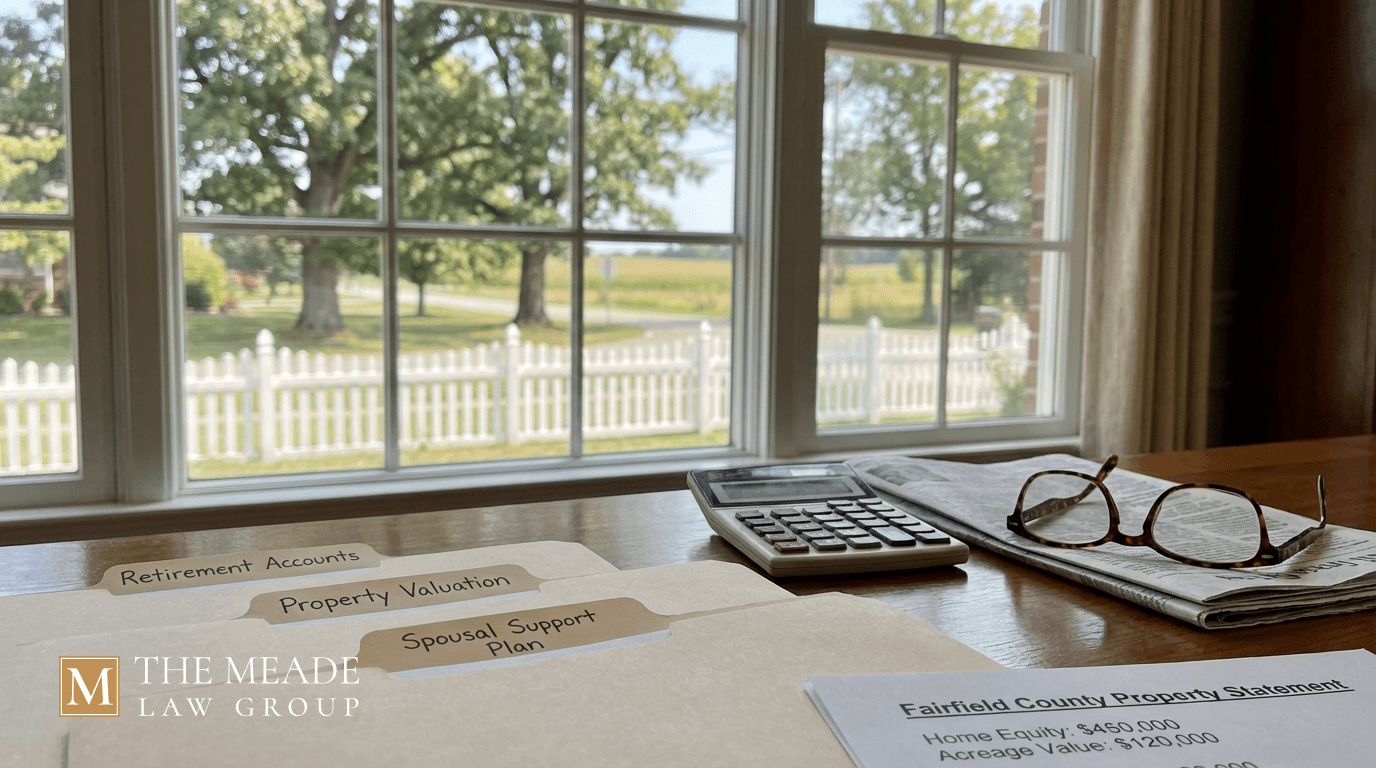

Imagine ending a decades-long marriage in Columbus, where you have built a life, raised a family, and planned for a quiet retirement. When divorce becomes a real possibility after 25 or 30 years of marriage, the financial consequences are no longer theoretical; they are immediate and long-lasting.
Where public-sector pensions and long-term real estate appreciation are common, a later-life divorce requires far more than emotional adjustment. With a population of approximately 1.33 million and a growing retiree community, many couples must untangle decades of shared finances while protecting their long-term financial stability.
A Grey Divorce in Franklin County introduces immediate concerns about pensions, healthcare coverage, and estate planning for older couples. The decisions made during this process can shape retirement security and long-term financial independence. Understanding your rights under Ohio law is the first step toward protecting the assets you have spent a lifetime building.
For a broader overview of how these issues are handled statewide, see our guide on Grey Divorce in Ohio.
Understanding Grey Divorce in Franklin County
Ohio law follows the principle of Equitable Distribution, meaning marital property is divided fairly but not always equally. Spousal Support decisions are also based on multiple financial factors rather than a strict formula. Courts evaluate the overall financial circumstances of the marriage to determine how assets and income should be handled during a later-life divorce.
At the local level, all divorce cases are filed and managed through the Franklin County Domestic Relations Court at 373 S. High St. in downtown Columbus. Judges apply Ohio law while reviewing the specific financial circumstances of each case. Because courts maintain discretion in interpreting these guidelines, familiarity with local procedures can influence how efficiently a divorce proceeds.
Why Divorce After 50 Requires a Different Strategy
Ending a marriage later in life presents distinct hurdles compared to divorcing in your thirties or forties. Navigating a senior divorce requires addressing unique financial realities before any settlement is reached.
The most pressing issue is the reality of a shorter career horizon and the impending shift to retirement living. In Columbus, these factors require a legal strategy focused heavily on asset preservation. Understanding these local challenges can help you prepare for the road ahead:
| Key Financial Reality | Why It Matters in a later-life Divorce |
| Shorter Recovery Time | Retirees have fewer working years left to rebuild their savings or recover from significant investment losses. |
| Fixed Income Status | Many older residents rely almost entirely on Social Security or state pensions. This makes steady and predictable cash flow vital for daily survival. |
| Asset Complexity | In Columbus, a paid-off house or a robust retirement portfolio often outweighs all other marital assets combined. |
Dividing Marital Property in a Later-Life Divorce
The division of property is often the most complex and contested phase of the legal process. In Central Ohio, property values and retirement accounts form the bulk of a couple’s marital wealth. Protecting these assets during a high-asset divorce requires precise legal and financial coordination.
Common assets divided in divorces include:
- Columbus Real Estate: With median home values around $301,000, determining whether to sell the marital home or negotiate a buyout can significantly affect the property division.
- State and Private Pensions: Government pensions, such as OPERS and Ohio State University retirement benefits, must be valued and divided accurately.
- Tax Impacts: Selling a highly appreciated Columbus home or liquidating investments prematurely can trigger severe capital gains taxes.
Because Columbus is home to massive public sector employers, dividing state pensions is particularly common in this county. Securing your share of these public benefits requires strict adherence to state administrative rules.
To split pensions and retirement accounts without facing early withdrawal penalties, the court requires a Qualified Domestic Relations Order (QDRO). Drafting a precise QDRO is a mandatory legal step to secure your rightful share of these critical retirement assets.
Financial Planning and Asset Valuation in a Senior Divorce
Accurate financial valuation determines the fairness of any settlement in a later-life divorce. In a later-life divorce in Central Ohio, the primary disputes often revolve around pension actuarial calculations, business valuation, deferred compensation, illiquid assets, and long-term tax forecasting.
Protecting your wealth requires sophisticated financial planning and a deep understanding of the Central Ohio economic landscape. Our approach focuses on several critical valuation areas:
- Defined-benefit pension valuation: Assessing OPERS and other public-sector retirement plans common among Columbus government employees.
- Executive compensation and stock benefits: Evaluating deferred compensation, stock options, and delayed payouts.
- Business or professional practice valuation: Ensuring closely held businesses and professional practices are not undervalued.
- Marital vs. separate property tracing: Distinguishing premarital assets from property accumulated during the marriage.
- Tax exposure analysis: Evaluating long-term tax consequences when dividing retirement funds or appreciated assets.
- Liquidity planning: Balancing cash assets with long-term investments such as real estate.
Spousal Support in Long-Term Marriages
In a later-life divorce, spousal support often determines whether a spouse can maintain stable housing, healthcare coverage, and a workable monthly budget. For established households balancing retirement planning with the cost of living in Columbus, support can play a major role in preserving day-to-day financial stability after the marriage ends.
Retirement does not automatically end a support obligation. When one spouse leaves the workforce or begins relying more heavily on a fixed income, the court must still decide whether a modification is appropriate based on the specific financial circumstances involved.
Under Ohio Revised Code 3105.18, courts review several financial and personal factors when deciding whether support is appropriate and, if so, in what amount and for how long. These commonly include:
- Earning ability: Each spouse’s realistic capacity to work and generate income after the divorce.
- Age and health: Physical or mental health conditions that may affect financial independence.
- Retirement resources: Pensions, Social Security eligibility, and other available income sources.
- Standard of living: The financial lifestyle established during the marriage and whether it can be reasonably maintained.
- Length of the marriage: Longer marriages often increase the likelihood of extended or ongoing support.
Healthcare and Benefits for Older Spouses After Divorce
Losing coverage under a spouse’s insurance plan is a terrifying prospect for individuals navigating a later-life separation. Planning medical coverage during divorce is absolutely critical to avoid dangerous gaps in care. Securing continuous coverage requires you to address healthcare costs during your settlement negotiations proactively.
Health Insurance After Divorce
Individuals under age 65 must find alternative coverage after divorce to bridge the gap before Medicare eligibility. Securing replacement insurance is a priority, as failure to plan coverage before the final decree can create immediate and severe financial strain.
Common health coverage options after divorce may include:
- COBRA continuation coverage: Allows a spouse to remain on an employer-sponsored plan for up to 36 months after divorce, though premiums are often higher.
- Private marketplace insurance: Individuals may purchase coverage through federal or state health insurance marketplaces.
- Employer-sponsored coverage: Some individuals obtain coverage through their own employment if they return to the workforce.
- Medicare eligibility: Individuals become eligible at age 65, which may create a temporary coverage gap before benefits begin.
Social Security Considerations
Social Security benefits are often an important financial component of divorce planning after 50. Divorced spouses may qualify for benefits based on an ex-spouse’s earnings record. To qualify for Social Security benefits based on a former spouse’s earnings record, several conditions generally apply:
- The marriage must have lasted at least 10 years.
- The applicant must be unmarried.
- The applicant must be at least 62 years old.
Post-Divorce Estate Planning and Beneficiary Updates
A final divorce decree legally ends your marriage, but it does not automatically update your estate plan. Leaving outdated documents in place can create serious financial consequences for your family or intended beneficiaries.
After a divorce is finalized, several estate planning updates should be completed as soon as possible:
- Update wills and trust documents: Remove your former spouse and revise how assets should be distributed.
- Change beneficiary designations: Update beneficiaries on retirement accounts, life insurance policies, and other financial assets.
- Revise powers of attorney: Appoint a trusted individual to make financial or medical decisions if necessary.
- Update payable-on-death bank accounts: Ensure that checking and savings accounts reflect your intended beneficiaries.
- Review life insurance policies: Confirm that policy proceeds will go to the correct family members or dependents.
Why Choose The Meade Law Group
Navigating a Grey Divorce in Franklin County requires dedicated and seasoned local representation. Our divorce attorneys possess extensive local experience in Central Ohio courts and a deep familiarity with the specific procedures used by domestic relations judges.
We are entirely committed to a retirement-focused legal strategy with a strong emphasis on high-asset protection during this critical life transition. When your retirement security is at stake, local experience is not optional; it is strategic.
Our Services Include:
- High-Asset Property Division: Detailed valuation and protection of Columbus real estate, pensions, executive compensation, and investment portfolios.
- Retirement Asset Protection: Drafting and reviewing Qualified Domestic Relations Orders to safeguard 401(k)s, OPERS pensions, and defined-benefit plans.
- Spousal Support Strategy: Developing sustainable support structures aligned with retirement timelines and Franklin County court practices.
- Business and Professional Practice Valuation: Protecting closely held businesses and professional partnerships from undervaluation.
- Post-Decree Modifications: Adjusting Support Obligations in Response to Retirement or Health Changes.
Contact The Meade Law Group to schedule a confidential consultation.
Frequently Asked Questions (FAQs)
| Question | Answer |
| Is equitable distribution always a 50/50 split in Franklin County? | No. Ohio law requires marital property to be divided equitably, which means fairly. While an equal split is the starting point, the court can adjust the division based on the specific financial circumstances of the marriage. |
| How long does a divorce take in Franklin County? | An uncontested divorce in Columbus can be finalized in a few months. However, a contested grey divorce with complex assets may take a year or longer to resolve in the local courts. |
| Will my spouse get half of my OPERS or retirement pension? | Retirement funds acquired during the marriage are considered marital property. They are subject to equitable division, but that does not guarantee an exact 50/50 split depending on how other assets are distributed. |
| Can I keep my Columbus home after the divorce? | Yes, if you can afford to buy out your spouse’s equity share. With local median home values around $301,000, you must carefully weigh the costs of a buyout against selling the property and splitting the proceeds. |
| Does retirement automatically end spousal support in Franklin County? | No. Unless specifically stated in the divorce decree, you must file a motion to modify support upon retirement to adjust your obligations formally. |