
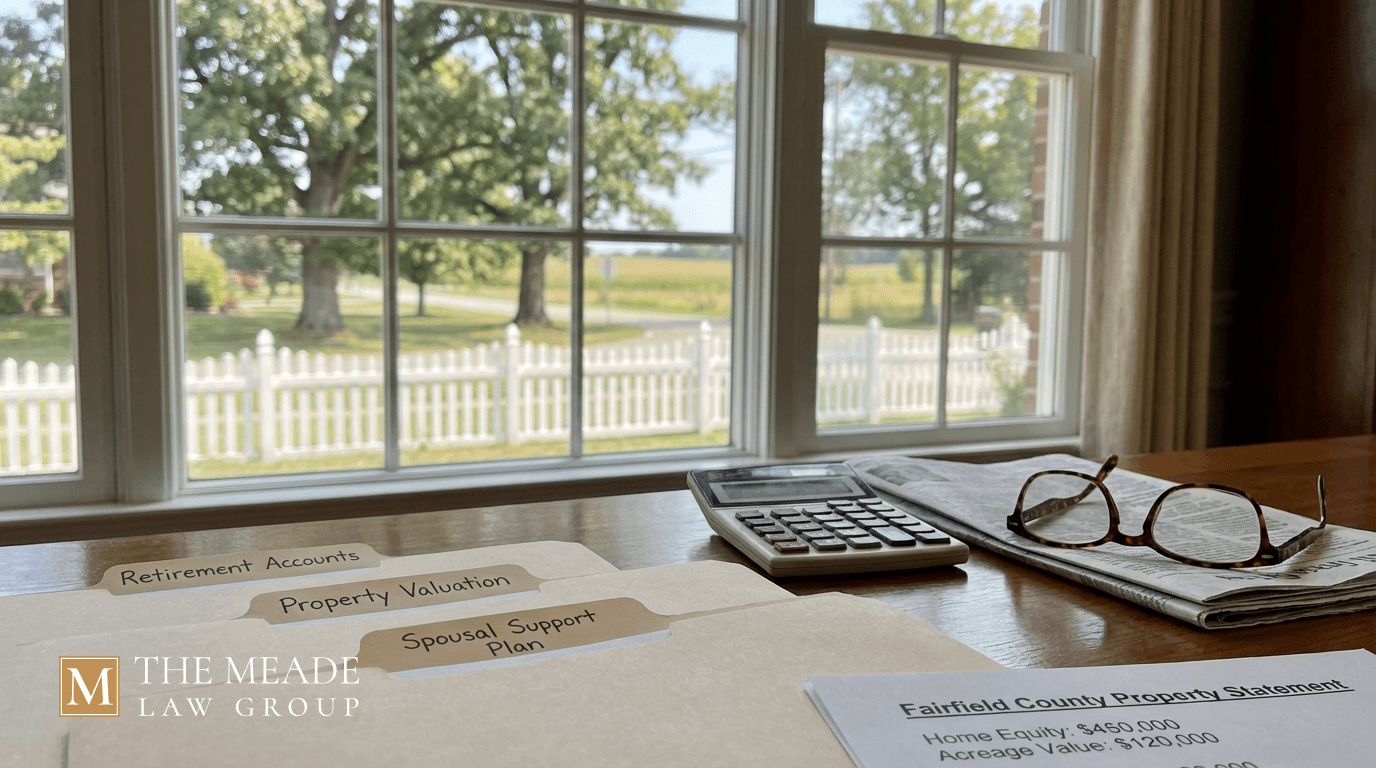
Dissolving a decades-long marriage represents a significant financial transition. For established households in Fairfield County, a separation involves unwinding a complex web of shared finances, rather than simply dividing checking accounts. Later-life divorce is less about rebuilding income and more about preserving the assets that will fund your retirement.
Navigating a Grey Divorce in Fairfield County means addressing the practical realities of long-held real estate, acreage, and intertwined family investments. Securing your independence requires a strategic approach to property division and future cash flow.
With a narrower financial recovery period, ensuring your post-divorce stability should become a central priority. Achieving a fair settlement requires careful attention to tax implications, healthcare continuity, and long-term support obligations.
For a broader overview of the legal and financial issues involved in divorce after 50 under Ohio law, see our Grey Divorce in Ohio guide.
Understanding Grey Divorce in Fairfield County
Ohio relies on equitable distribution to divide property, which means assets are allocated fairly, though not always equally. In long-term marriages, achieving fairness requires a sophisticated analysis of asset types, future tax liabilities, and liquidity needs. Furthermore, spousal support in Ohio is highly discretionary, making the clear presentation of your financial reality essential.
In Fairfield County, later-life divorces can involve long-held residential property, acreage, and overlapping family finances. A fair settlement depends on a clear presentation of liquidity needs, tax-adjusted value, and future cash flow. Your case will proceed through the domestic relations court system in Lancaster, where local procedure can affect timelines and documentation requirements.
Why Divorce After 50 Requires a Different Strategy
A separation after 50 demands a fundamentally different legal approach than a divorce in your thirties. The primary legal objective must shift from anticipating future income growth to strategically protecting the wealth you have already established.
These practical realities dictate the focus of your settlement negotiations:
| Financial Reality | Why It Matters in Divorce After 50 |
| Shorter Recovery Horizon | There are fewer working years left to rebuild depleted savings or recover from an unfavorable property settlement. |
| Retirement Income Dependence | Future cash flow will likely rely on fixed pensions, Social Security, and investment withdrawals rather than a steady salary. |
| Asset Preservation Priority | The legal strategy must focus on safeguarding accumulated wealth, as future earnings will not be sufficient to replace what is lost. |
| Liquidity Risk | Retaining high-value illiquid assets, such as a large family home or acreage, does not guarantee the cash flow needed for daily living expenses. |
| Need for Long-Term Predictability | Financial instability is highly disruptive later in life, making predictable support and reliable income essential. |
Structuring a Property Settlement That Supports Retirement
Dividing property during a divorce is rarely a straightforward split. Instead of merely dividing accounts, the agreement must be deliberately structured to support your retirement stability, protect your liquidity, and help maintain a manageable long-term cash flow.
Assets that carry a high paper value but lack liquidity can quickly become financial burdens if they do not fund your daily living expenses. A sustainable approach focuses on how each asset functions in your everyday post-divorce life.
A well-structured settlement typically accounts for the following categories of financial risk:
- Long-Held Real Estate: Evaluating the costs of retaining a primary residence, vacation homes, or local acreage against the need for accessible cash.
- Retirement Portfolios: Splitting IRAs, 401(k)s, and brokerage accounts while prioritizing steady, reliable future income.
- Business Interests: Addressing the valuation risks and operational complexities of dividing a family-owned or closely held enterprise.
- Separate Property: Tracing inheritances and premarital wealth to ensure these distinct assets are shielded from marital division.
Protecting Retirement Income in a Later-Life Divorce
Retirement savings often serve as the financial foundation for couples over fifty. Mistakes when dividing these accounts can reduce your long-term financial security, so careful attention to detail matters.
Depending on the specific plan, a Qualified Domestic Relations Order (QDRO) may be required to transfer funds safely. When drafted correctly, a QDRO allows you to divide these accounts without triggering early withdrawal fees or unwanted tax liabilities. Relying on generalized assumptions during this phase can lead to significant financial setbacks.
Tax Consequences of Asset Division: Liquidity and Cash Flow Risks
An equal division on paper rarely means an equal division after taxes. Hidden tax exposure and transaction costs can significantly change the true value of your settlement, directly affecting your available cash flow. Securing a fair outcome requires evaluating the real after-tax value of each asset.
Key tax and cash-flow issues to evaluate include:
- Capital Gains Exposure: Liquidating appreciated investments or selling real estate can result in sudden, heavy tax obligations.
- Retirement Transfer Risk: Executing account rollovers incorrectly can generate severe penalties and avoidable income tax.
- Deferred Compensation Treatment: Handling executive bonuses or equity shares requires analyzing complex tax timing and vesting schedules.
- Investment Income Effects: Recognizing how taxable dividends and interest will affect your everyday post-divorce budget.
Spousal Support in Long-Term Marriages
Spousal support is often a major point of contention in marriages lasting several decades. When one spouse has a reduced earning capacity after years out of the workforce, or when both spouses are nearing retirement, support payments can determine whether post-divorce life remains financially stable.
Under Ohio Revised Code 3105.18, there is no strict formula for determining spousal support. Instead, judges review multiple financial and personal factors, including:
- Length of the marriage: Marriages lasting several decades often justify longer or indefinite support periods.
- Earning ability: The realistic capacity of each spouse to re-enter the workforce or increase their current income.
- Age and health: Physical or mental health conditions that may limit financial independence.
- Retirement benefits: The pensions and Social Security eligibility available to each party.
- Standard of living: The lifestyle established during the marriage, which courts aim to reasonably maintain.
It is important to note that reaching retirement age does not automatically end an existing support obligation. Modifying or terminating spousal support requires formal legal action and a court review of your changing financial circumstances.
Healthcare and Social Security Considerations
Older spouses are particularly vulnerable to insurance disruption and the loss of shared benefits. Because healthcare costs can easily destabilize a settlement, benefit planning must be a central part of your later-life divorce strategy.
Health Insurance After Divorce
You generally cannot remain on a former spouse’s employer-sponsored health plan once the divorce is finalized. Because coverage planning must be addressed during settlement negotiations, it is vital to explore alternative options early.
Common pathways for health insurance coverage include:
- COBRA Continuation: Electing to remain on the employer-sponsored plan temporarily, though premiums are typically much higher.
- Private Marketplace Coverage: Purchasing an individual health insurance policy through state or federal exchanges.
- Employer-Sponsored Alternatives: Securing a new policy through your own employer if you are currently working.
- Medicare: Transitioning to federal benefits once you reach the eligibility age of 65.
Social Security Benefits
Protecting your income streams through Social Security benefits is a vital component of retirement planning. While these federal benefits are not divided by the Ohio divorce court, a divorced spouse may still qualify for derivative benefits based on their former partner’s earning record.
To claim these benefits, the following standard eligibility requirements generally apply:
- The marriage must have lasted for at least 10 consecutive years.
- The applicant claiming the benefit must be currently unmarried.
- The applicant must be at least 62 years old.
Post-Divorce Estate Planning and Beneficiary Updates
A final divorce decree legally dissolves your marriage, but it does not automatically fix your estate documents. Many of these documents stay unchanged unless you update them. This is a critical and often overlooked reality of the divorce process.
Failing to update these documents can leave decision-making control with an ex-spouse, direct assets to the wrong person, and create avoidable family conflicts. Following your divorce, you should promptly complete your estate planning updates:
- Wills and Trusts: Revising your core documents to reflect your new single status and intended heirs.
- Financial Powers of Attorney: Revoking your former spouse’s authority to make financial decisions on your behalf.
- Healthcare Powers of Attorney: Appointing a new trusted individual to make medical decisions if you become incapacitated.
- Beneficiary Designations: Removing your ex-spouse from your life insurance policies and retirement accounts.
- Payable-on-Death Accounts: Updating the transfer instructions for your local bank accounts and investment portfolios.
Why Choose The Meade Law Group
Managing a senior divorce requires a strategic, financially sophisticated approach. At The Meade Law Group, we help clients protect what matters most after decades of shared finances: retirement income, home equity, and long-term stability. Our guidance focuses on building settlement terms that support real-world cash flow and reduce avoidable financial risk.
Because the stakes are higher later in life, small mistakes can have permanent consequences. We approach grey divorce cases with disciplined financial planning, careful documentation, and clear settlement structuring designed to preserve independence into retirement.
Our Services Include:
- Settlement Structuring for Retirement Stability: Build settlement terms around reliable post-divorce income and manageable monthly obligations.
- Real Estate Equity and Buyout Planning: Evaluate sell versus buyout decisions with attention to refinancing risk, maintenance costs, and liquidity.
- QDRO Drafting and Retirement Division Execution: Ensure retirement transfers are handled correctly to avoid penalties and protect long-term income.
- Tracing Separate Property and Inheritance Claims: Identify and document non-marital assets to prevent avoidable commingling disputes.
- Support Orders Built for Retirement Timelines: Negotiate or challenge support terms with realistic retirement dates and income transitions in mind.
Contact The Meade Law Group to schedule a confidential consultation.
Frequently Asked Questions (FAQs)
| Question | Answer |
| Is equitable distribution always a 50/50 split in Fairfield County? | No. Ohio law requires that marital property be divided fairly, but this does not guarantee an exact equal split. The court considers the specific financial realities of your marriage to determine a fair allocation. |
| How long does a grey divorce typically take in Fairfield County? | The timeline depends heavily on the complexity of your financial documentation, the need for business or retirement asset valuations, and whether you pursue negotiation versus contested litigation. Court scheduling and local procedures also play a role in the duration. |
| Will my spouse receive part of my retirement accounts? | Yes, it is highly likely. The portion of a retirement account earned during the marriage is generally considered marital property. However, pre-marital contributions may be protected if properly traced. |
| How does owning acreage or inherited property affect division in an Ohio divorce? | It depends on whether the property is characterized as marital or separate. Tracing the origin of the asset is crucial, as commingling funds over decades can change the property’s legal classification. |
| Can I keep the marital home after the divorce? | Yes, if you have the financial means to buy out your spouse’s share of the equity. However, you must carefully evaluate ongoing maintenance and mortgage costs to ensure it does not cause severe liquidity strain. |
| Does retirement automatically end spousal support? | No. Retiring does not automatically stop your obligation to pay support. You must file a formal motion with the court to request a modification or termination of the order. |