
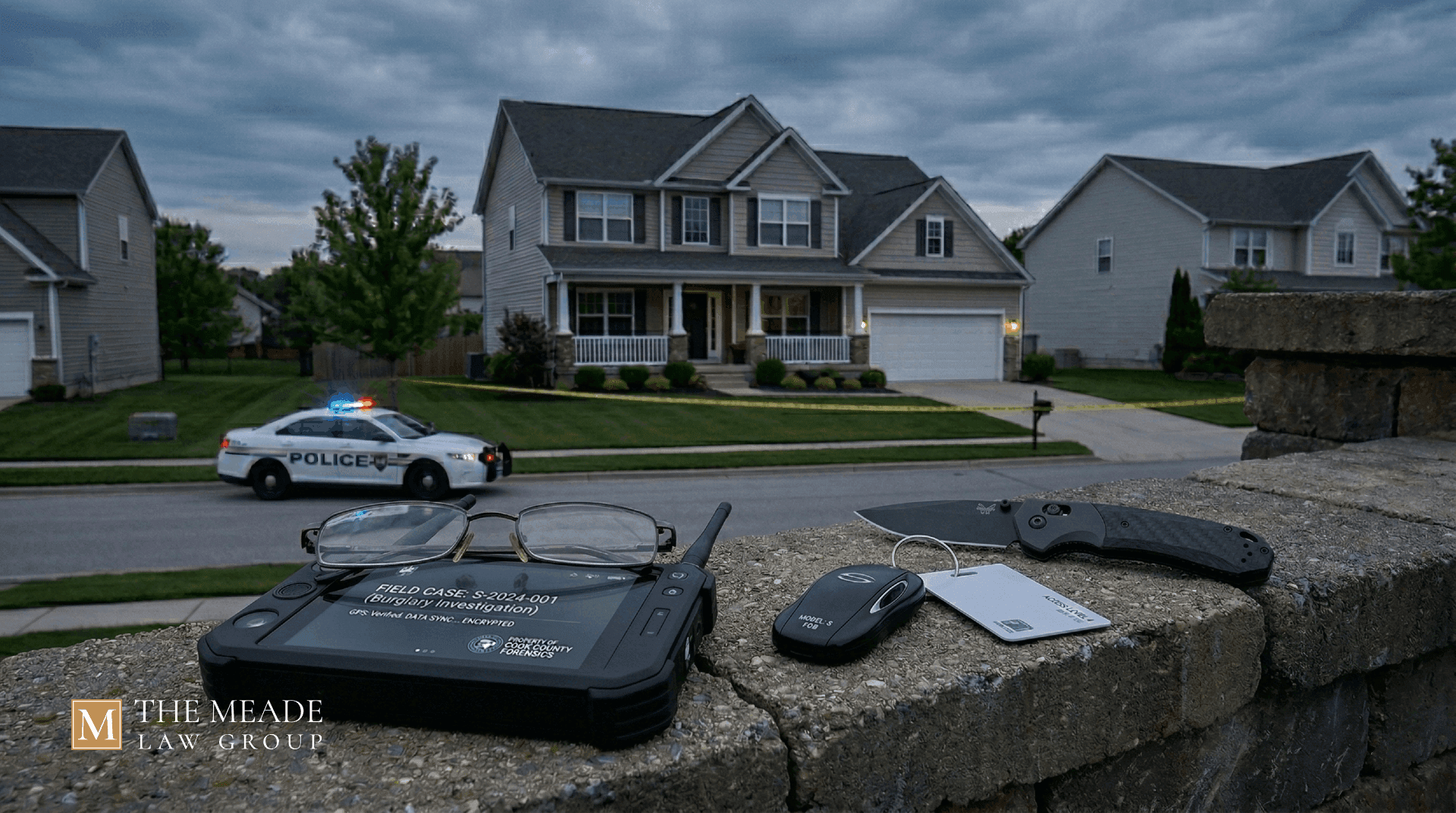
Discovering that you are the target of a police investigation for a property crime is deeply unsettling. When the allegations involve entering a home illegally, the stress can make it difficult to focus on anything else. You are likely worried about possible jail time, the impact on your reputation, and how a criminal record could affect your ability to work and support your family.
The Ohio criminal justice system moves fast. Prosecutors often start building their case before a formal arrest. This fast pace leaves many people confused and pressured to explain themselves to law enforcement. During this stressful period, uninformed decisions can seriously damage your defense.
You must clearly understand the laws they use against you to navigate this situation. Knowing how Ohio defines these offenses, what penalties you may face, and what steps to take next is essential to protecting your rights. A careful look at the law can help you and your attorney build a strong, practical defense strategy.
Understanding Burglary Charges in Ohio
In everyday conversation, people often use the word “burglary” to describe a situation where someone breaks into a house and steals valuable items. Under Ohio law (ORC 2911.12), however, the legal definition focuses entirely on the entry itself rather than the theft. You can be charged with this serious felony even if nothing was actually stolen from the property.
The core issue in a burglary case is the unlawful entry into an occupied structure with the specific intent to commit a criminal offense. The state treats these situations severely because unlawfully entering a home or building creates a risk to the people inside. This focus on public safety results in serious felony charges that require an informed and highly focused legal defense.
What Prosecutors Must Prove in an Ohio Burglary Case
In any criminal case, the prosecution carries the heavy burden of proving guilt beyond a reasonable doubt. It is not enough for the state to simply show that you were present on someone else’s property. To secure a burglary conviction, the state generally must prove several specific elements:
- Trespass: The accused entered or remained without permission.
- Force, Stealth, or Deception: The entry happened through a legally prohibited method.
- Occupied Structure: The incident involved a structure covered by Ohio law.
- Criminal Intent: The accused intended to commit a crime inside.
Force, Stealth, or Deception
One of the first questions in a burglary case is how the entry happened. The prosecution must show that the accused used force, stealth, or deception to enter. Ohio law does not require dramatic property damage or an obvious forced entry in every case.
- Force: This can be as minimal as turning a doorknob and pushing open an unlocked door without permission.
- Stealth: This involves sneaking into the building or deliberately remaining undetected to avoid discovery.
- Deception: This occurs when someone lies or uses a false pretense to trick the owner into allowing them inside.
If the prosecution fails to prove that the entry involved one of these three specific methods, the burglary charge may be significantly weakened.
Occupied Structure and Criminal Intent
The second key part of a burglary charge is the building’s legal type and the accused person’s intent when entering. The state must prove both elements simultaneously. Simply being inside a building unlawfully is a trespass, but it only becomes a burglary if the specific structure and intent requirements are met.
- Occupied structure: This broadly includes any permanent or temporary dwelling, even if the residents are away at the time.
- Presence matters: The law also covers any building where a person is actually present or likely to be present.
- Criminal intent: The prosecution must prove the individual entered with the specific intention to commit a crime once inside.
- Not limited to theft: The intended crime does not have to be stealing; intending to commit an assault or cause property damage also satisfies this requirement.
If the state cannot prove both the nature of the structure and the required criminal intent, the burglary charge may be much harder to prove.
Burglary vs. Aggravated Burglary in Ohio
While standard burglary is already a serious felony, the law recognizes a higher, more severe classification for incidents that present an immediate danger to human life. Understanding the difference between these two charges is essential for evaluating the potential penalties you face.
When a Burglary Charge Becomes More Serious
Aggravated burglary (ORC 2911.11) represents a much more severe legal allegation. A standard burglary charge elevates to aggravated burglary when the accused unlawfully enters an occupied structure with criminal intent, and another person who is not an accomplice is actually present.
In addition to someone being present, the state must prove an additional aggravating factor. This means the accused must have inflicted, attempted to inflict, or threatened physical harm on someone, or they must have possessed a deadly weapon or dangerous ordnance during the incident. These added factual allegations result in a first-degree felony charge and much stricter penalties.
Burglary vs. Breaking and Entering vs. Criminal Trespass
Ohio law strictly categorizes property and entry offenses based on the nature of the structure and the specific intent of the accused. Recognizing these legal distinctions is critical because they dictate the severity of the potential penalties.
| Charge | Basic Definition | Type of Structure | Intent Required | Usual Severity |
| Burglary | Trespass by force, stealth, or deception | Occupied structure | Intent to commit a criminal offense | Felony level depends on the facts |
| Breaking and Entering | Unlawful entry by force, stealth, or deception | Unoccupied structure or certain premises | Intent to commit a theft offense or felony | Generally, a fifth-degree felony |
| Criminal Trespass | Entering or remaining without permission | Land or premises of another | No additional criminal intent required | Typically a misdemeanor |
Understanding these differences matters. The structure type and your reason for entry can change the charges. They can also change the possible penalties.
Penalties for Burglary Charges in Ohio
Ohio imposes serious penalties for burglary and related entry offenses, but the exact penalty depends entirely on the specific facts and the felony level charged. Standard burglary does not fall into a single fixed penalty category.
Under ORC 2911.12, burglary outcomes are separated by subsection. The charge can fall into different felony levels depending heavily on whether people were present or likely to be present.
- Trespass in a Habitation: Generally charged as a fourth-degree felony when the trespass involves a habitation where a person is present or likely to be present.
- Third-Degree Felony: Applies to certain burglary cases involving an occupied structure where no person was present or likely to be present.
- Second-Degree Felony: Applies to more serious burglary cases, usually when a person was present or likely to be present. Some qualifying cases may involve indefinite sentencing.
- First-Degree Felony (Aggravated Burglary): Punishable by a minimum of 3 to 11 years in prison, subject to indefinite sentencing extensions.
In addition to prison time, courts can impose heavy financial penalties under ORC 2929.18. Maximum fines can reach up to $10,000 for a third-degree felony, up to $15,000 for a second-degree felony, and up to $20,000 for a first-degree felony.
Beyond prison time and fines, a felony conviction creates a permanent criminal record. This brings severe collateral consequences, including lifelong employment barriers, extreme difficulties in securing housing, and the permanent loss of your right to possess a firearm.
Common Defenses to Burglary Charges
Being charged with a crime does not mean a conviction is guaranteed. Because these charges rely on strict statutory definitions, a strong defense focuses on whether the prosecution can actually prove the required elements of the offense beyond a reasonable doubt.
Lack of Intent, Mistaken Identity, and Weak Evidence
The best defense strategy depends entirely on the evidence and the specific allegations in your case. Common defense concepts include:
- Lack of Intent: Proving that you had no intention to commit a crime inside the structure. For example, entering a property due to a genuine misunderstanding.
- Mistaken Identity: High-stress situations, poor lighting, and chaotic scenes frequently lead to unreliable eyewitness memory and false identifications.
- Consent or Reasonable Belief: Demonstrating that you had permission, or a reasonable belief that you had permission, to enter the premises.
- Failure to Prove “Occupied Structure”: Challenging the state’s claim that the building met the legal definition of an occupied structure at the time of the incident.
- Failure to Prove Force, Stealth, or Deception: Showing that the entry did not involve the methods required by the burglary statute.
- Weak or Insufficient Evidence: Challenging the prosecution’s lack of physical proof, such as the absence of DNA, fingerprints, or reliable video surveillance.
What Happens After a Burglary Arrest or Charge in Ohio
Understanding the chronological flow of a criminal case helps lower anxiety and allows you to make informed decisions at each stage. Every phase represents a critical point where legal counsel can influence the outcome.
- Arrest or Summons: The process begins when you are taken into custody or formally ordered to appear in court.
- Arraignment: The judge formally reads the charges against you, and you enter an initial plea.
- Bond or Release Conditions: The court decides if you will be released pending trial and sets strict conditions, such as no-contact orders.
- Discovery Phase: The prosecution must turn over the evidence they intend to use against you, allowing your defense team to find weaknesses.
- Pretrial Hearings: Your attorney meets with the prosecutor and the judge to discuss the status of the case and resolve scheduling issues.
- Plea Negotiations or Motion Practice: Your defense may file motions to suppress illegal evidence or negotiate for reduced charges.
- Trial: If a fair resolution cannot be reached, the case moves to trial, where the state must prove its case to a judge or jury.
What to Do Next If You Are Accused of Burglary
Your actions in the hours and days following an accusation can significantly impact the outcome of your case. Taking the right practical steps immediately is essential for protecting your rights and preventing irreversible mistakes.
- Remain Silent: Do not attempt to explain your situation to law enforcement without a lawyer present.
- Do Not Contact the Alleged Victim: Reaching out to the property owner or witnesses can result in additional charges for intimidation.
- Preserve All Evidence: Secure text messages, receipts, video footage, phone data, and location history that could establish an alibi.
- Follow Bond Conditions: Adhere strictly to any rules set by the judge, including curfews and travel restrictions.
- Contact a Defense Attorney: Secure legal counsel quickly to review the charges and prevent harmful early mistakes.
Why Choose The Meade Law Group
Facing burglary charges in Ohio requires a clear understanding of state property laws and a strategic approach. At The Meade Law Group, we start by evaluating your case early and looking closely at the state’s evidence. We focus on identifying weak points in the prosecution’s theory from the very beginning.
We understand the significant impact these allegations have on both your personal and professional life. Our team steps in quickly to help clients avoid mistakes during investigations. We develop a comprehensive defense plan, thoroughly preparing to protect your rights, whether through negotiation or trial.
Our Services Include:
- Early Case Evaluation: Reviewing the initial reports and evidence to understand exactly what the state can and cannot prove.
- Property Crime Defense Strategy: Building a defense plan tailored to the specific details of burglary, breaking, or trespass allegations.
- Evidence Review and Suppression: Scrutinizing witness statements and forensic evidence for procedural flaws or constitutional violations.
- Trial Representation: Providing focused courtroom advocacy if a fair pre-trial resolution cannot be reached.
Contact The Meade Law Group to schedule a confidential consultation.
Frequently Asked Questions (FAQs)
| Question | Answer |
| Can you be charged with burglary if nothing was stolen? | Yes. Burglary focuses on the unlawful entry into an occupied structure with the intent to commit a crime. You can be charged even if you steal nothing. |
| Is burglary always a felony in Ohio? | Yes. In Ohio, burglary and aggravated burglary are felonies. They range from fourth-degree to first-degree felonies. The exact level depends on the charge. |
| What is the difference between burglary and robbery? | Burglary involves unlawful entry into a structure with the intent to commit a crime. Robbery involves committing or attempting to commit a theft offense while using or threatening physical force against a person. |
| Can I be charged with burglary if the door was unlocked? | Yes. Force is not strictly required. Trespassing by stealth or deception, or simply opening an unlocked door without permission, satisfies the entry element of the charge under Ohio law. |
| Can a burglary charge be reduced? | Yes. Depending on the evidence, an attorney may negotiate a reduction to a lesser charge, such as breaking and entering or criminal trespass, if the state cannot prove criminal intent or an occupied structure. |
| Will a burglary conviction affect my record or gun rights? | Yes. A felony burglary conviction creates a permanent criminal record and will strip your right to possess a firearm under both Ohio and federal law. |