
January 2026

Golden scales of justice on a wooden desk balancing documents labeled Immediate Needs and Bills against Long-Term Equity and Future Planning, illustrating the difference between temporary and permanent spousal support in Ohio alongside a gavel and legal paperwork.

Temporary vs. Permanent Spousal Support in Ohio

Entering the divorce process often brings a wave of financial uncertainty that can feel overwhelming. One of the most pressing concerns for many individuals is the fear of losing their standard of living or being unable to cover basic expenses once they no longer share a household.  This is where the concept of spousal support, historically known as alimony, becomes a critical part of legal discussions. In Ohio, the legal system aims to ensure an equitable transition, but the distinction between the different types of support can be confusing.  You may wonder if you will receive help immediately or if you will be supported for years to come. Understanding the difference between temporary and permanent spousal support is crucial for protecting your financial future during this challenging time. Why Spousal […]

Temporary vs. Permanent Spousal Support in Ohio Read More »

Close-up of reading glasses and a fountain pen on a legal document, representing the detailed evidence review required to prove a substantial change in circumstances for modifying child support, spousal support, and custody orders under Ohio law.

Substantial Change in Circumstances in Ohio: Post-Decree Modifications Explained

Under Ohio law, a substantial change in circumstances is the primary legal threshold for modifying an existing court order for spousal support, child support, or custody. To qualify for a modification in an Ohio domestic relations court, the change must generally be substantial, involuntary, and unforeseen at the time of the original decree.  This shift must make the current order unfair or unworkable. Without meeting this specific standard, Ohio courts typically lack the authority to alter a final divorce decree or shared parenting plan. Whether you are facing an involuntary job loss, a medical crisis, or a significant shift in your family’s needs, understanding how to navigate a substantial change in circumstances in Ohio is critical to aligning your legal obligations with your current reality. Ohio Legal Definition of a

Substantial Change in Circumstances in Ohio: Post-Decree Modifications Explained Read More »

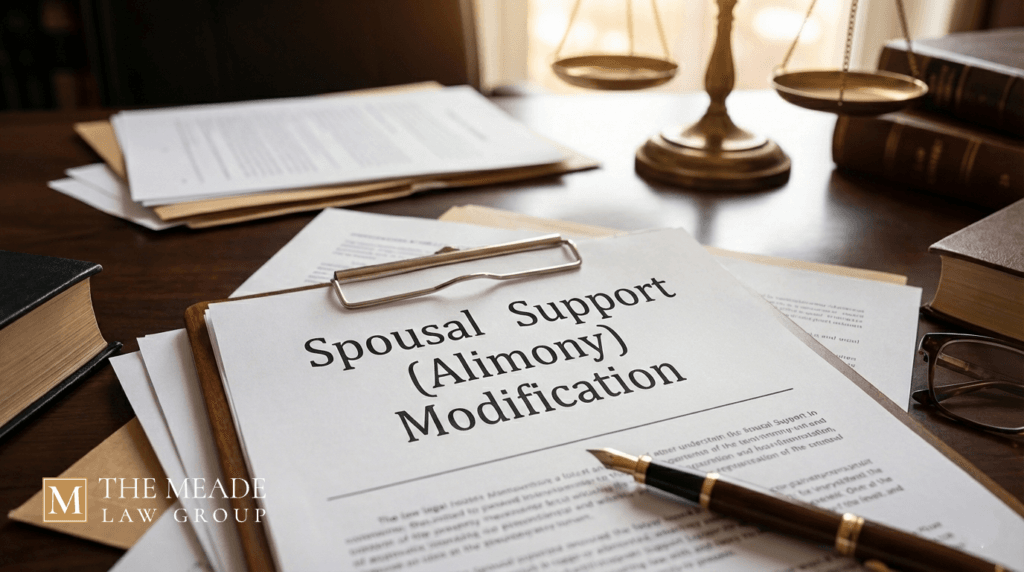
Legal document titled "Spousal Support (Alimony) Modification" on a law office desk with scales of justice, representing Ohio alimony modification laws.

Spousal Support (Alimony) Modification in Ohio: What You Need to Know

When a marriage ends, a court may order one spouse to provide financial assistance to the other. This arrangement, known as spousal support, is designed to ensure that both parties can maintain a stable standard of living following the divorce or dissolution. However, life does not remain static after a legal decree is signed. Financial circumstances and personal situations can change significantly after a divorce. Ohio law allows for adjustments to support obligations when these changes affect a person’s ability to pay or their actual need for assistance. Understanding Spousal Support Under Ohio Law The legal concept of spousal support in Ohio is rooted in the principle of equity and necessity.  It is not intended to be a punishment for the paying spouse or a lifelong windfall for the recipient,

Spousal Support (Alimony) Modification in Ohio: What You Need to Know Read More »

Professional legal desk with law books and a house model, representing strategic Ohio divorce planning and property division.

Common Mistakes in Ohio Divorce Planning

Entering the divorce process is one of the most significant transitions an individual can experience. It is a period defined by emotional weight, but it is also a high-stakes legal and financial event. Decisions made during the initial stages often resonate for decades, affecting retirement security, property rights, and the stability of the parent-child relationship. In Ohio, a successful outcome is built on strategy rather than chance. Many damaging mistakes occur quietly before the process even begins, with consequences that may surface years later. By prioritizing Ohio divorce planning instead of reacting to events as they unfold, you can protect your long-term interests and ensure your future is built on a solid legal foundation. Why Divorce Planning Matters Under Ohio Law While many people focus only on the final hearing,

Common Mistakes in Ohio Divorce Planning Read More »

A wooden gavel resting on an official Motion to Show Cause document, representing the legal consequences and enforcement of court orders in Ohio.

What Happens When You Are in Contempt of Court in Ohio?

Imagine receiving a formal document stating that a motion has been filed against you because you missed several support payments.  Or perhaps you withheld visitation rights over a weekend dispute and are now summoned to appear before a judge. Situations like these can escalate quickly from a personal disagreement to a serious legal matter. Court orders are binding mandates rather than suggestions. When a judge signs a decree regarding custody, support, or property division, ignoring these directives leads to significant consequences affecting your finances, freedom, and future rights.  Ohio courts rely on this authority to ensure the judicial system functions correctly. Without a method to address non-compliance, rulings would be unenforceable, and the legal process would lose its ability to resolve disputes. Understanding the legal process surrounding these allegations is

What Happens When You Are in Contempt of Court in Ohio? Read More »

Legal documents and a magnifying glass on a wooden desk, symbolizing the court's review process in an Ohio child custody relocation case.

Child Custody & Relocation in Ohio: What Parents Need to Know Before Moving

Child custody and relocation disputes rank among the most challenging family law issues. Under Ohio custody law, when a parent wants to relocate or plans to move, it can disrupt a child’s routine, emotional bonds, and relationships with both parents. Ohio law always prioritizes the child’s best interest (or the interest of the child) above everything else. This detailed guide covers the full legal framework for Ohio child custody and relocation, step-by-step processes, key factors courts evaluate, common pitfalls, and strategies for success. Whether you are the relocating parent or the one opposing a move, understanding these rules helps protect your rights, custody arrangements, and your child’s well-being. Understanding Relocation in Ohio Child Custody Cases Ohio does not impose a strict mileage threshold for relocation. Instead, any move that substantially

Child Custody & Relocation in Ohio: What Parents Need to Know Before Moving Read More »

Magnifying glass examining a Financial Disclosure Affidavit and Ohio tax forms on a legal desk to investigate financial dishonesty in a divorce case.

What Happens If My Spouse Lies in an Ohio Divorce?

In an Ohio divorce, the legal system relies on both parties providing a full and honest disclosure of their circumstances. Every participant has a legal duty to be truthful when submitting sworn documents or testifying in court. When a spouse chooses to be dishonest, it does more than just break the rules. Deceit often leads to significant delays, increased legal fees, and unnecessary stress for any children involved. Dishonesty can also fundamentally alter your financial settlement, parenting schedule, and property division. This article explains the legal expectations of honesty in Ohio and the consequences of lying in divorce proceedings. What Is Considered “Lying” in an Ohio Divorce? Legal dishonesty occurs when a party intentionally provides incorrect information or omits material facts to influence the case outcome. This behavior is distinct

What Happens If My Spouse Lies in an Ohio Divorce? Read More »

A father and child walking together in a bright, professional hallway, symbolizing the protection of parental rights and the bond between parent and child during Ohio custody cases.

How False Allegations Affect Child Custody in Ohio

Ohio courts evaluate how well each parent can meet a child’s needs and support a positive relationship with the other parent. While allegations aren’t taken at face value, temporary protective measures may be issued if there’s an early indication of risk, under Ohio Revised Code § 3109.04. False claims can derail custody decisions, turning careful evaluations of parenting into defensive battles. They affect emergency orders, long-term plans, and the parent-child relationship during critical transitions. While false allegations often arise during divorce proceedings. This guide focuses specifically on how those claims impact child custody decisions in Ohio. For a broader understanding of how false allegations can impact your divorce beyond custody, read our full guide here. Understanding Ohio’s Child Custody Framework Ohio’s custody system operates under a framework designed to prioritize

How False Allegations Affect Child Custody in Ohio Read More »

Legal documents for an Ohio divorce case showing a motion to dismiss false allegations on a law office desk with a fountain pen and tablet.

How False Allegations Can Impact Your Divorce in Ohio

Divorce is already an emotionally charged process, but false allegations can add an entirely new layer of complexity. Whether made in an attempt to gain leverage in custody battles or simply out of spite, false claims can drastically alter the course of a divorce case. In Ohio, false allegations not only harm reputations but can also influence child custody, spousal support, and the final property division. This article explores how Ohio courts address these claims and what you can do to protect yourself if you are accused unjustly. What Are False Allegations in an Ohio Divorce? A false allegation in a divorce case refers to any statement made in court that is demonstrably untrue or lacks a solid evidentiary basis. These claims are often introduced to influence the court’s perception

How False Allegations Can Impact Your Divorce in Ohio Read More »

Alt tag: Comparison of contested and uncontested divorce paths in Ohio featuring a legal setting with a desk, legal documents, and professional advocacy for family law cases.

Contested vs. Uncontested Divorce in Ohio: Choosing The Right Path

Ending a marriage is a profound emotional and practical transition. As you face questions about financial stability and your children’s future, you will encounter a critical legal crossroads: determining whether your case will proceed as contested or uncontested. In Ohio, a dissolution is a joint action where both spouses have fully agreed on all terms before filing, making the process generally straightforward, while a divorce may be uncontested if parties later reach an agreement, or contested if disputes remain. We at The Meade Law Group help clients navigate their options under Ohio law, assess their legal situation, and provide strategic guidance tailored to their individual circumstances. Divorce Under Ohio Law: Basic Framework In Ohio, the legal termination of a marriage is handled through the domestic relations court system. Before a

Contested vs. Uncontested Divorce in Ohio: Choosing The Right Path Read More »